

Understanding Your Responsibilities as a Standard Business Sponsor (SBS)

Nov 13, 2025 | News

Sponsoring skilled workers through programs like the Temporary Skill Shortage (subclass 482) or Skilled Employer Sponsored Regional (subclass 494) means you have important obligations. These rules protect both Australian workers and your overseas hires and keep the sponsorship process fair and transparent. In this post, we’ll outline the key legal obligations you need to understand […]

Sponsoring skilled workers through programs like the Temporary Skill Shortage (subclass 482) or Skilled Employer Sponsored Regional (subclass 494) means you have important obligations. These rules protect both Australian workers and your overseas hires and keep the sponsorship process fair and transparent.

In this post, we’ll outline the key legal obligations you need to understand before sponsoring your first skilled migrant employee. Knowing these requirements early helps your business stay compliant and ensures a smoother sponsorship process from start to finish.
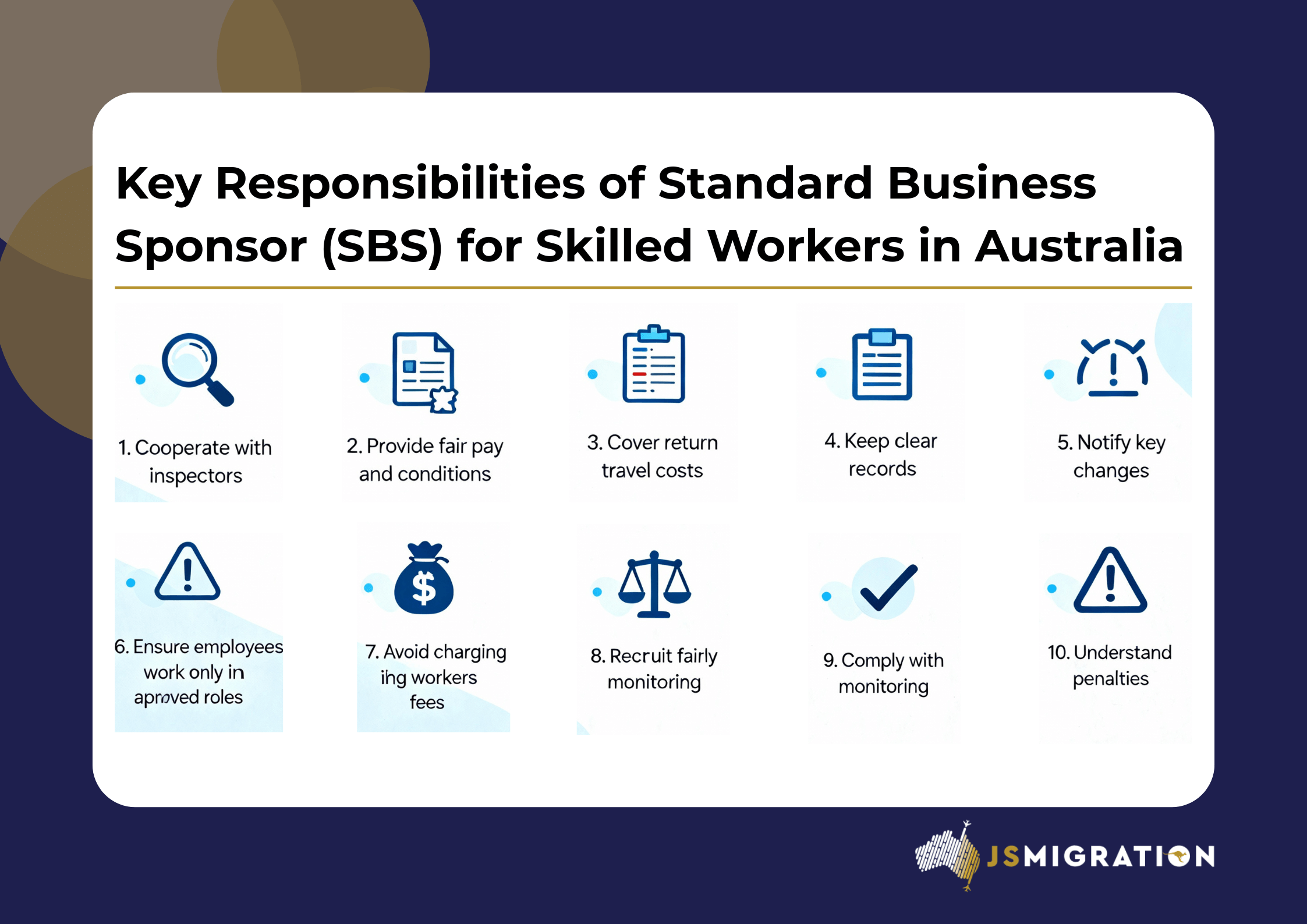
 

Cooperate with Inspectors — Stay Ready

Expect visits or requests from Department of Home Affairs (DOHA) inspectors or other agencies. They might want to look at your records or speak with staff to check compliance. This oversight starts when your sponsorship is approved and lasts up to five years after it ends.

Fair Pay and Working Conditions — Treat Everyone Equally

Your sponsored employees should never be paid less or treated worse than their Australian counterparts in the same role. Their wages must match what you nominated, and working conditions should be equal or better—unless their income is above $250,000 per year, then some exceptions apply.

Cover Return Travel Costs — Helping Workers Go Home

If a sponsored worker (or their family) requests in writing to return to their home country, you’re responsible for reasonable travel expenses. This usually means economy flights back home.

Government Costs — Be Accountable if Workers Overstay

If the government must track down and remove a sponsored employee who overstays, your business might have to repay those removal costs—up to $10,000.

Keep Clear Records — Paperwork Matters

Maintain thorough and verifiable records, including employment contracts, job duties, business turnover for levies, and any training benchmarks if relevant. Keep everything for at least five years in case DOHA asks to review them.

Provide Information When Asked — Respond Promptly

When the Minister or DOHA asks for information or documents, reply within the timeframe specified to avoid issues.

Notify DOHA About Important Changes — Keep Them in the Loop

Within 28 days, inform DOHA if an employee stops working for you, changes roles, or if there are changes in business ownership, insolvency, or your contact details.

Sponsored Employees Must Stick to Approved Roles — No Side Gigs

Workers should only perform the duties listed in their approved nomination. They must be directly employed by you or your associated company — not loaned out to others.

Don’t Shift Sponsorship Costs to Employees — You Cover It

You cannot charge your sponsored workers any fees for sponsorship, visa processing, recruitment, or government levies. These remain your obligation as the employer.

Recruit Fairly — No Discrimination Allowed

Use visa programs only to fill genuine skill shortages after checking for suitable Australian candidates. Recruitment should always be nondiscriminatory, regardless of nationality or visa status.

Compliance Checks and Monitoring — They’re Watching

DOHA regularly monitors sponsors through document requests, site visits (often unannounced), and data sharing with agencies like the ATO or Fair Work Ombudsman.

Penalties for Non-Compliance — Serious Consequences

Failing to meet your obligations can lead to sponsorship suspension, cancellation, future bans, public naming, fines up to $63,000 per breach, or even legal action.


💡 Need Help Navigating Your Sponsorship Duties?

Understanding these rules might feel overwhelming, but you don’t have to face it alone. If you receive monitoring requests or want to double-check your compliance, contact JS Migration right away. Acting early can save you from bigger problems down the line.

You may also like:

Planning to Apply for a Partner, Parent or Family Visa Onshore? Proposed Changes May Affect Your Options

Reports indicate that the Australian Government is considering policy shifts that could prevent Visitor visa holders from lodging onshore Partner, Parent, or Family visa applications. Because these reported restrictions would require affected family members to apply from offshore without an onshore Bridging Visa, prospective applicants should urgently review their eligibility under current rules.

Benefits of Australian Permanent Residency (PR): Everything You Need to Know

Becoming an Australian Permanent Resident (PR) is a transformative life event that grants individuals and families long-term stability, world-class healthcare through Medicare, unrestricted employment opportunities, and a clear pathway to Australian citizenship. However, while permanent residency grants you the right to remain in Australia indefinitely, many visa holders are unaware that the international travel facility attached to their PR visa is valid for only five years.

Direction 119: New Skilled Visa Processing Priorities

A significant change has been introduced to the processing of Australian skilled visa applications. Ministerial Direction 119 came into effect on 25 July 2026, replacing the processing priorities previously established under Direction 105. Importantly, it applies to...

Family Violence Visa Protections in Australia: A Complete Guide

Eligible Australian visa applicants can safely leave abusive relationships and still pursue permanent residency by providing supporting evidence of family violence.

Partner Visa Australia 2026: Requirements, Costs & Timeline

The Partner Visa remains Australia’s most popular pathway for spouses and de facto partners to reunite and build a life together in 2026. Whether applying onshore (subclass 820/801) or offshore (subclass 309/100), success depends on proving a genuine and continuing relationship, meeting the AUD 9,365 main applicant fee, and preparing strong supporting evidence. With median temporary visa processing around 18 months, early professional preparation is key to avoiding delays and refusals.

Why Australian Visas are Refused in 2026: 7 Critical Reasons & Expert Fixes

In 2026, the Australian Department of Home Affairs has significantly tightened its scrutiny of temporary visas, resulting in record-high refusal rates for student and visitor streams. This article outlines the seven most common pitfalls—ranging from the new “Genuine Student” test to increased financial thresholds—and provides legal insights on how to protect your application from a “Section 501” or “PIC 4020” rejection.

Why Comparing Your Australian Visa Journey to Others Does More Harm Than Good

Seeing other people’s visa approvals online can make your own Australian visa journey feel delayed or uncertain. This article explains why comparing timelines is misleading, how it leads to rushed decisions, and why focusing on your own pathway is the smarter approach.

Is 2026 the Right Year to Apply for Permanent Residency in Australia?

Deciding whether to apply for Permanent Residency (PR) in Australia is a major life choice — one that affects your future, your family’s stability, and your long-term plans. As we enter 2026, many temporary visa holders (students, skilled workers, families, and...

New Year Resolutions for Future Australian Migrants: Start Your Journey Now

The start of a new year is the perfect time to set goals and make plans — and if migrating to Australia is on your list, now is the moment to act. Planning ahead can save months, or even years, of delays and ensure a smoother path for you and your loved ones. From...

What Happens to Australian Visa Processing Over the Holidays? What Applicants Should Know

The holiday season is a time for reflection, rest, and spending meaningful moments with loved ones. For many people planning or already navigating their Australian migration journey, however, this period can also bring questions and uncertainty — particularly around...