

If you are currently in Australia on a temporary visa and planning to apply for a Partner (Subclass 820/801), Parent, or Child visa, timing is critical.
Reports indicate the Australian Government is evaluating key updates to onshore visa pathways. Under proposed policy adjustments, certain family members of Australian citizens and permanent residents may no longer be allowed to lodge permanent Family visa applications while holding a Visitor visa.
If implemented, these changes would require eligible spouses, children, and parents to lodge their applications from offshore—requiring them to wait overseas throughout the entire processing period.
These measures have not yet been formally announced or implemented. However, people who are already planning an onshore Family visa application should not delay reviewing their eligibility and options.
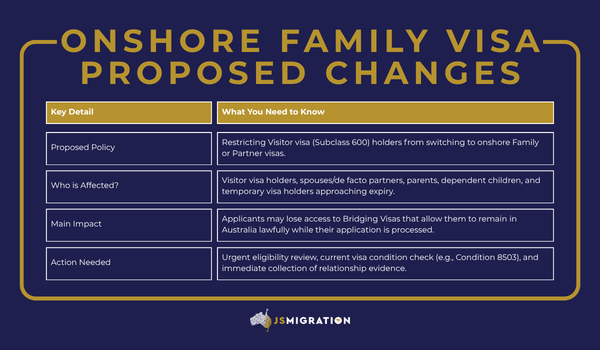
What Is Being Proposed for Onshore Family Visas?
Under current Australian migration settings, eligible family members who enter Australia on a valid temporary visa—and whose visas do not carry restrictive conditions—can often lodge an onshore application. This grants them an onshore Bridging Visa, allowing them to remain in Australia legally with work and study rights while waiting for a decision.
Reports from ABC News highlight that the Government is evaluating restrictions on this “onshore switching” pathway for tourist and visitor visa holders.
Read the ABC News article: Proposed Australian Migration Changes
Why Is the Government Considering This?
- Migration System Integrity: Reducing temporary-to-permanent onshore transitions (often referred to as “visa hopping”).
- Net Overseas Migration Control: Aligning onshore arrivals with broader population management strategies.
Because parts of the broader reform package remain under review, there is no confirmed commencement date or final legislative instrument. However, Australian migration changes can take effect immediately upon announcement without prior public notice.
Who May Be Affected by These Changes?
You should assess your options immediately if you:
- Are currently in Australia on a Visitor Visa (Subclass 600) or ETA.
- Are the spouse or de facto partner of an Australian citizen, permanent resident, or eligible New Zealand citizen.
- Are preparing an onshore Partner Visa (Subclass 820/801) application.
- Are exploring an onshore pathway as an eligible parent or aged relative.
- Plan to enter Australia as a tourist with the intent to apply for a Family visa after arrival.
- Hold a temporary visa approaching its expiration date.
Note: Not all visitor visas permit onshore applications. Eligibility depends on your specific visa subclass, individual circumstances, and existing visa conditions.
Why Acting Early Matters for Prospective Applicants
Waiting for an official government announcement could mean losing your window of opportunity. Historically, migration rule updates include specific commencement dates, and it is uncertain whether transitional provisions will protect unlodged draft applications.
Key Steps to Take Right Now:
- Verify Your Onshore Eligibility: Ensure you meet the legal criteria for both the sponsorship and visa subclass.
- Audit Your Visa Conditions: Check for restrictive conditions such as Condition 8503 (No Further Stay) or Condition 8531, which prohibit lodging most onshore applications without a formal waiver.
- Compile Decision-Ready Relationship Evidence: Incomplete applications carry high risks of refusal or delay.
- Evaluate Offshore vs. Onshore Options: Determine if applying offshore (e.g., Subclass 309/100 Partner Visa) is a safer, more strategic route.
Checklist: Essential Evidence for Onshore Partner Visas (Subclass 820)
If you are planning an onshore Partner visa application, the Department of Home Affairs evaluates evidence across four key pillars:
Financial Aspects
Joint bank accounts, shared household expenses, residential leases, or joint asset ownership.
Household Nature
Shared domestic responsibilities, mail addressed jointly, and care arrangements for dependents.
Social Context
Evidence of social recognition, joint travel, statutory declarations from family/friends (Form 888), and photos together over time.
Mutual Commitment
Personal relationship statements detailing the history, development, and long-term plans of your partnership.
Frequently Asked Questions (FAQs)
What if I have already lodged my onshore Family visa application?
If you have already lodged a valid application, proposed rules typically do not apply retroactively. Your application will continue to be processed under the rules in effect at the time of lodgement.
Can I travel to Australia on a tourist visa to apply for a Partner visa?
Under the current requirements, you may be able to apply for an onshore Partner visa if you meet the relevant eligibility criteria and your Visitor visa does not contain a “No Further Stay” condition, such as condition 8503.
If the proposed changes are implemented, certain Visitor visa holders may no longer be permitted to apply for a Partner visa while in Australia.
As the appropriate strategy depends on your circumstances and visa conditions, always obtain professional migration advice before applying for a Visitor visa or making travel arrangements.
Proposed Australian visa changes may limit Visitor visa holders from applying onshore family visa. Learn how to protect your future with your family in Australia
What is Condition 8503 (No Further Stay)?
Condition 8503 is an endorsement attached to certain visitor visas that prevents you from applying for another visa while in Australia (except under extreme, unforeseen circumstances). If this condition is on your visa, you cannot lodge an onshore partner or family visa unless a waiver is granted.
How JS Migration Can Help
Navigating changing Australian immigration policy requires clear strategy, strict compliance, and fast execution. Based in Northgate, Brisbane, JS Migration provides registered, ethical, and tailored migration advice to help families stay together.
Our experienced Registered Migration Agents assist you to:
- Perform an urgent eligibility and visa condition assessment.
- Identify legal risks, including Condition 8503 and Schedule 3 criteria.
- Review and compile decision-ready relationship evidence.
- Prepare and lodge well-supported onshore or offshore applications prior to policy changes.
Take Action Before Policy Changes Occur
Don’t leave your family’s future in Australia to chance. Contact JS Migration today to review your onshore visa options.
- Website: www.jsmigration.com
- Location: Northgate, Brisbane QLD
- Phone: +61 7 3073 1410
- Email: visa@jsmigration.com
Disclaimer: This article provides general informational content only and does not constitute formal migration legal advice. Migration regulations change frequently. Consult a Registered Migration Agent (MARA) for advice specific to your circumstances.