
Family violence can have a devastating impact on a person’s safety, wellbeing, family life, and immigration status. In many cases, visa applicants feel trapped or pressured to remain in an unsafe or abusive relationship out of fear of losing their pathway to permanent residency in Australia.
You do not have to stay in an unsafe relationship to keep your visa.
Australian migration law explicitly recognizes this vulnerability. Under Division 1.5 of the Migration Regulations 1994, specific family violence provisions allow eligible visa applicants to continue their journey toward permanent residency—even if the relationship with their Australian sponsor, spouse, de facto partner, or primary applicant has ended.
Key Criteria: Do You Qualify for the Family Violence Provisions?
The Department of Home Affairs states that no applicant is required to remain in a relationship where they fear for their safety or wellbeing.
For the family violence provisions to apply, five core criteria must generally be met:
- Eligible Visa: You must hold, or have applied for, an eligible Australian visa.
- Experience of Abuse: You or your dependants have experienced family violence.
- Perpetrator Identification: The perpetrator was the former partner, spouse, sponsor, or primary visa applicant.
- Timing: At least part of the family violence occurred while the relationship was ongoing.
- Relationship Breakdown: The relationship has officially ended (partially or fully due to the abuse).
Important Note: Separation from a sponsor does not automatically result in a visa refusal. If family violence is involved, your legal position changes significantly and must be evaluated under specific migration rules.
Which Visas Are Covered by the Family Violence Provisions?
While many applicants worry about their immigration status after leaving a relationship, these protections apply across several onshore and offshore visa subclasses:
1. Onshore and Offshore Partner Visas
- Partner visa subclass 820/801 (Onshore temporary and permanent)
- Partner visa subclass 309/100 (Offshore temporary and permanent, under specific circumstances)
- Prospective Marriage visa subclass 300 (Where the applicant entered Australia and the relevant marriage or relationship requirements are met)
2. Secondary Applicants on Permanent Visas
The family violence visa protections also extend to secondary applicants under selected skilled, business, and family visa streams. This protects dependents who have suffered family violence inflicted by the primary visa applicant.
Defining Family Violence Under Australian Migration Law
For migration purposes, family violence is not limited to physical assault. The legal definition encompasses any conduct—whether actual or threatened—that causes a person to fear for their safety, wellbeing, or the safety of their children.
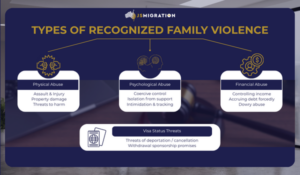
Common examples under Australian migration standards include:
- Physical & Sexual Abuse: Hitting, choking, restraining, forced physical acts, or property damage.
- Threats Relating to Migration: Threatening to cancel a visa, withdraw sponsorship, contact the Department of Home Affairs, or have you deported.
- Coercive Control & Emotional Abuse: Constant monitoring, tracking, isolation from family and friends, humiliation, or psychological intimidation.
- Financial Abuse: Controlling all funds, refusing allowance for necessities, preventing employment, or forcing debt into your name.
- Cultural & Dowry Abuse: Extortion or ongoing demands for money, property, or gifts from the victim’s family.
How the Department of Home Affairs Assesses Your Claim
When processing a domestic violence partner visa claim after a relationship ends, the Department of Home Affairs evaluates two primary factors:
- The Genuine Relationship Requirement: The Department must be satisfied that a genuine and continuing relationship existed prior to the breakdown (assessing financial, household, social, and mutual commitment aspects).
- The Family Violence Assessment: The Department then evaluates the evidence confirming that family violence occurred during the relationship.
Proving Family Violence: Required Evidence
Evidence is the backbone of any family violence visa application. Migration law recognizes both judicial and non-judicial evidence.
| Evidence Type | Examples / Accepted Documentation |
| Judicial Evidence | • Court injunctions • Family Violence Orders (FVO) or Apprehended Violence Orders (AVO) • Court convictions or findings of guilt against the perpetrator |
| Non-Judicial Evidence | Reports, letters, or declarations from approved professionals, including: • Medical practitioners & registered nurses • Police officers • Registered psychologists & social workers • Family violence support workers • School principals or child welfare officers |
In addition to professional reports, applicants are generally required to provide a comprehensive Statutory Declaration detailing the relationship history, specific incidents of violence, relevant dates, safety fears, and the long-term impact of the abuse.
What If You Don’t Have a Police Report?
Many victims do not contact the police immediately due to fear, trauma, cultural barriers, financial dependency, or threats regarding their visa status.
The absence of a police report does not invalidate your claim. You can still satisfy the legal requirements using non-judicial evidence from qualified professionals and a properly drafted statutory declaration.
Precedent Cases: Why Strategy and Detail Matter
Key precedent cases—such as Perez v Minister for Immigration and Border Protection [2017], Karsten v Minister for Immigration [2019], and Nugrohowati v Minister for Immigration [2022]—underscore how critical precise legal preparation is.
These cases demonstrate that claims can face severe scrutiny if:
- There is confusion regarding whether the abuse occurred during the relationship.
- The Department or Independent Expert notes inconsistencies in timeline or statements.
- Specific threats regarding visa status or deportation were omitted or poorly documented.
- There were delays in bringing the claim forward without proper context (such as trauma or coercive control).
Actionable Steps: Protecting Your Safety and Migration Status
If you are currently experiencing domestic or family violence, your immediate physical safety comes first.
🛡️ Safety Checklist for Applicants:
- Secure Communications: Create a new, private email address that your partner or sponsor cannot access.
- Update Passwords: Change passwords to your ImmiAccount, personal emails, social media, and bank accounts.
- Store Critical Documents: Keep safe digital or hard copies of passports, identity papers, birth certificates, and relationship evidence.
- Emergency Contacts: Call 000 if you are in immediate danger, or contact 1800RESPECT (1800 737 732) for confidential support.
- Seek Specialized Legal Guidance: Speak to an expert before updating the Department of Home Affairs about a relationship breakdown.
How JS Migration Can Help You Navigate Your Claim
Navigating migration law while dealing with trauma requires sensitive, experienced, and strategic legal support. At JS Migration, we offer end-to-end assistance with total confidentiality.
We support you by:
- Assessing your eligibility under Division 1.5 family violence regulations.
- Formulating a protective migration strategy before notifying Home Affairs of a relationship breakdown.
- Gathering, auditing, and organizing non-judicial and judicial evidence.
- Drafting clear, legally grounded statutory declarations and detailed legal submissions.
- Representing you in all correspondence with the Department of Home Affairs and independent experts.
Take the First Step Toward Safety and Certainty
No one should feel forced to endure abuse to remain in Australia. The law provides pathways to safeguard both your well-being and your permanent residency goals. If your relationship has ended due to abuse, or if you fear that leaving will impact your visa status, reach out for professional advice as early as possible.
Disclaimer: The information provided above is for general educational purposes only and does not constitute formal migration or legal advice. Family violence migration matters are complex and highly fact-specific. Consult a Registered Migration Agent or qualified legal practitioner to discuss your specific circumstances