General Skilled Migration (GSM)

What is General Skilled Migration (GSM)
General Skilled Migration is Australia's points-tested migration framework for skilled workers whose skills are in demand in Australia. It lets you apply for permanent or provisional visas based on your skills, qualifications, and work experience, not employer sponsorship.
Under the GSM program, the major visa subclasses currently in use are:
- Skilled Independent (Permanent) Visa (Subclass 189)
- Skilled Nominated (Permanent) Visa (Subclass 190)
- Skilled Work Regional (Provisional) Visa (Subclass 491)
Each visa has its own requirements and benefits — but they all start with the SkillSelect Expression of Interest (EOI).
Points Test — The Core of GSM
All GSM visas require a points scoreof at least 65.
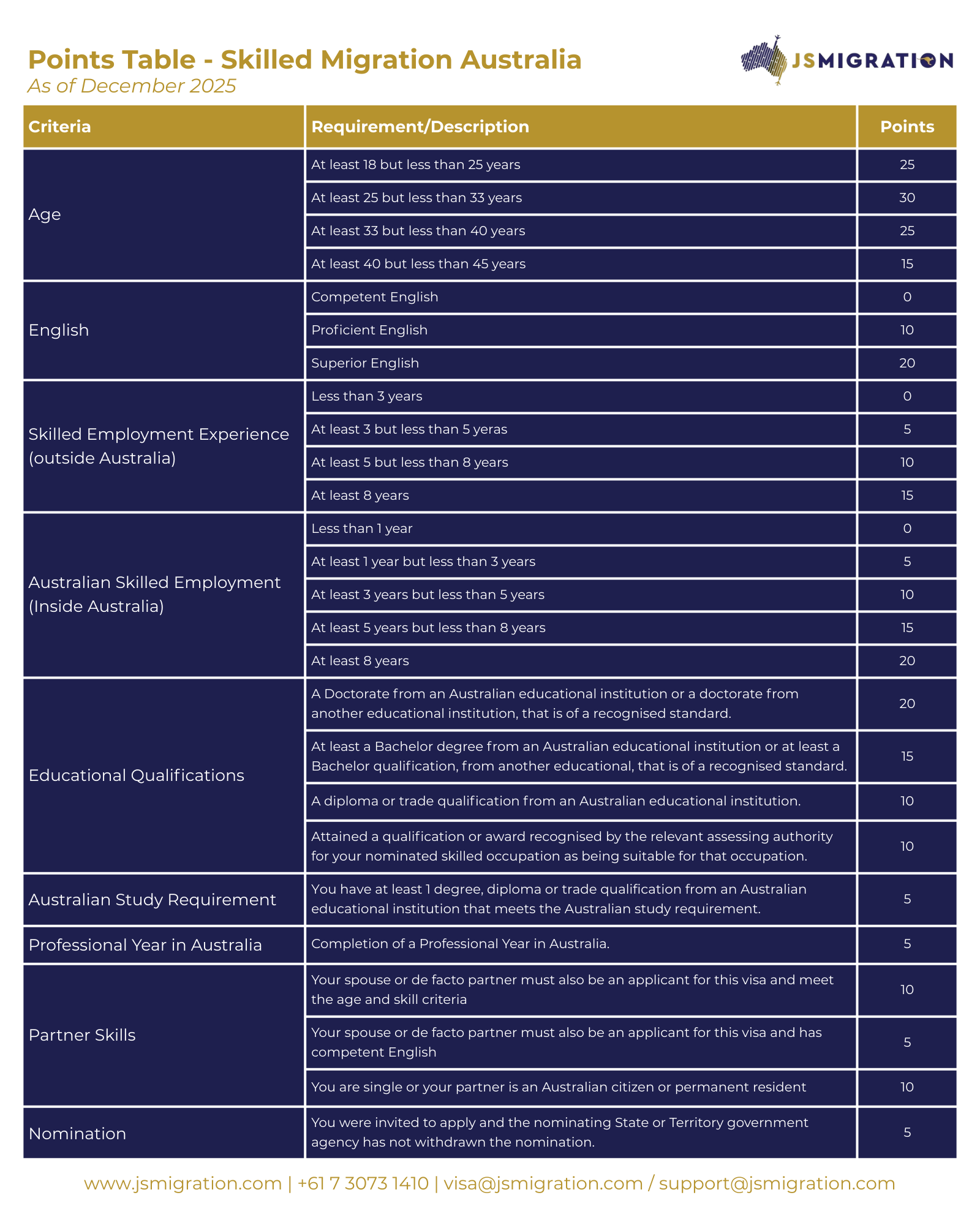
GSM Visa Subclasses
Detailed Breakdown for GSM Visa Subclasses
Skilled Independent Visa
Subclass 189
Overview
A permanent residency pathway designated for highly skilled professionals who are not sponsored by an employer, a state or territory government, or a family member. This visa allows successful applicant to:
- Live and work anywhere in Australia with full flexibility.
- Access Medicare (Australia's public health system).
- Study in Australia without restrictions.
- Sponsor eligible family members to join you.
- Apply for Australian citizenship once eligibility requirements are met.
This visa is points-tested,meaning applicants must meet minimum points requirements based on factors such as age, English proficiency, work experience, and qualifications. It is particularly suited for individuals who want independence in choosing where to live and work in Australia, without being tied to a sponsoring employer or state nomination.
Key Features
- No nomination required. You can apply independently — no state/territory or relative sponsorship needed.
- Permanent residency on grant.
- Work and study rights throughout Australia.
- Family members included if eligible
Eligibility Requirements
- Occupation on the relevant skilled list
- Positive skills assessment before EOI
- Meet the 65+ points requirement (often higher to get invited)
- Competent English
- Meet health & character requirements
- Under 45 years old at the time of invitation (Your age is locked in at the time of invitation — if you become 45 before the invite, you may be eneligible.
Application Process
- Skills Assessment
- English Test
- Submit EOI
- Receive invitation
- Apply online via ImmiAccount
- Provide supporting documents & medical checks
- Visa decision (processing times vary — often 6 to more than 9 months time)
Skilled Nominated Visa
Subclass 190
Overview
A permanent residency pathway for skilled workers who are formally nominated by an Australian state or territory government. It is designed for applicants whose skills are in demand locally and who are willing to contribute to the regional workforce.
- Live and work permanently in Australia with full residency rights.
- Study without restrictions at Australian institutions.
- Access Medicare
- Sponsor eligible family members for permanent residency.
- Apply for Australian citizenship once residency requirements are met.
This visa is points-tested, with eligibility determined by factors such as age, English proficiency, work experience, and qualifications. A key requirement is securing a state or territory nomination, which often prioritizes applicants with skills critical to that region. In return, visa holders are generally expected to live and work in the nominating state or territory for a period of time.
Key Features
- State/Territory nomination required—the state nominates you based on skill needs.
- This nomination gives you an extra +5 points towards the points test.
- Permanent residency upon grant—
Eligibility Requirements
- Meet all core GSM criteria
- Obtain state/territory nomination (approval required)
- Minimum points (65) including nomination bonus (usually +5)
- Occupation may be from STSOL or MLTSSL depending on priorities.
Nomination Process
Each state/territory (NSW, VIC, QLD, SA, WA, etc.) has its own criteria, invitation rounds, and occupation priorities — and often additional requirements such as:
- Nomination application submission
- Demonstration of genuine interest to settle within the designated state
- Evidence of ties or commitment to the state
Once nominated, your EOI score increases and you may receive an invitation to apply.
Skilled Work Regional (Provisional) Visa
Subclass 491
Overview
A temporary visa designed to encourage skilled migrants to live and work in regional Australia. It provides a pathway to permanent residency through the Subclass 191 visa, provided eligibility requirements are met.
- Valid for up to 5 years, offering long-term residence in designated regional areas.
- Work and study in regional Australia with full flexibility.
- Sponsor eligible family members to join you.
- Access Medicare
- Pathway to permanent residency via the subclass 191 visa once conditions are satisfied.
This visa is points-tested and requires nomination by a state or territory government or sponsorship by an eligible family member residing in a designated regional area. Holders are expected to live, work, and study in regional Australia, helping to support local communities and address skill shortages outside major cities.
Key Features
- Provisional visa valid for 5 years.
- Regional living requirement—you must live, work and study in designated regional areas.
- You must be nominated by a state/territory government or sponsored by an eligible relative living in a regional area.
- State nomination gives +15 points towards the points test.
Eligibility Requirements
- Skills Assessment
- Points test (65+ including nomination/sponsorship)
- Nomination by a state/territory or sponsorship by an eligible relative in regional Australia.
The nomination ads +15 points to your EOI score, significantly boosting your competitiveness.
Pathway to PR
After at least 3 years of regional work and residence, you can transition to Subclass 191 — Permanent Residence (Skilled Regional) under conditions set by the Department.
This pathway requires meeting income, residence and work conditions.
Skilled Migration Process
Phase 1 - Eligibility and Planning your GSM Pathway
Before you can lodge an Expression of Interest of apply for any GSM visa, you must first meet Australia's core eligibility requirements.
This planning stage is critical — mistakes here affect your points, eligibility, or even lead to a refusal.
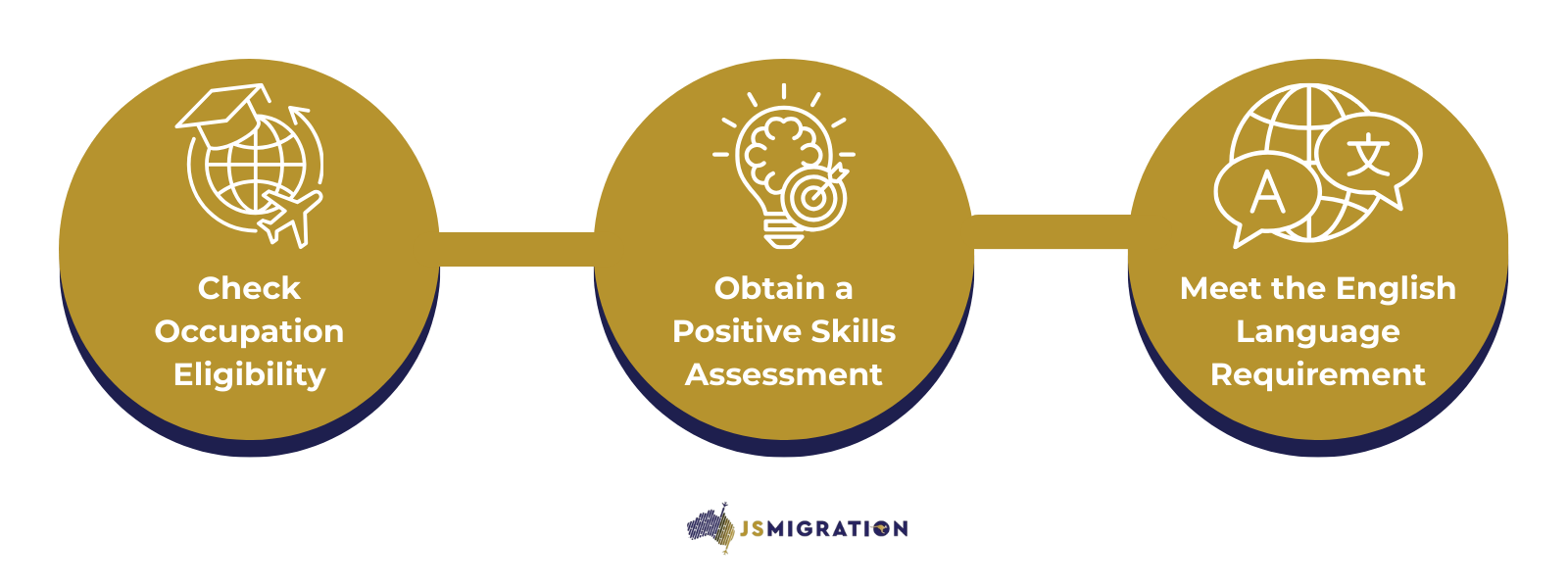
Step 1 Check Occupation Eligibility
Your nominated occupation must appear on Australia's skilled occupation lists taht apply to GSM visas. The main lists used are:
- Medium and Long-Term Strategic Skills List (MLTSSL)
Used accross all GSM visas — subclass 189, 190, and 491.
- Short Term Skilled Occupation List (STSOL)
Commonly used for state-nominated visas such as subclass 190 and 491.
- Regional Occupation List (ROL)
Specific to regional visas, including subclass 491.
Only occupations on the relevant list are eligible for skilled migration. If your occupation is not listed, you cannot proceed under GSM.
Step 2 Obtain a Positive Skills Assessment
A skills assessment is mandatory for GSM visas and must be completed before submitting your EOI.
- You must apply to the authorised assessing body for your occupation
Engineers Australia, VETASSESS, ACS, TRA, etc.
- The assessment confirms that your qualifications and work experience meet Australian standards.
- Each assessing authority has different criteria, document requirement, and assessment methods.
Processing time: Most skills assessment take 8-12 weeks or longer, depending on the authority and completeness of documents.
Step 3 Meet the English Language Requirement
You must demonstrate your English proficiency through an approved English language test: IELTS, PTE Academic, TOEFL iBT, or OET.
The minimum requirement for GSM visas is usually Competent English, but higher scores significantly improve your points and competitiveness. English points under the GSM points test:
- Competent English → 0 points
- Proficient English → +10 points
- Superior English → +20 points
Higher English scores are often a key factor in receiving an invitation.
Phase 2 - EOI, Invitation, Visa Application and Outcome
Once your documents and eligibility are ready, the process moves into its most critical phase. This stage starts with submitting your EOI and continue through invitation to apply, visa lodgmentm and final assessment by the Department of Home Affairs.
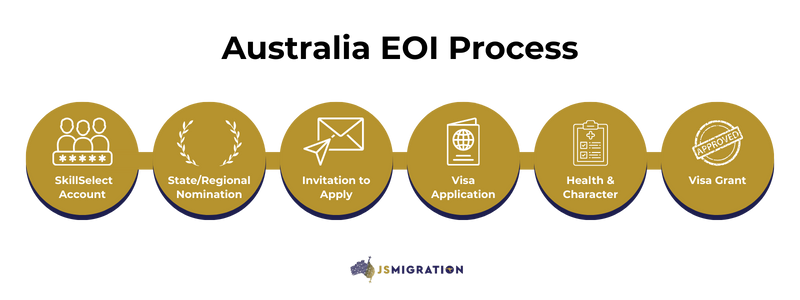
Step 4 EOI in SkillSelect
Profile must be submitted to the system.
- Lodge your EOI online via SkillSelect
- Points are calculated automatically
- Select visa subclasses and nomination preferences (if application)
EOI remains valid for up to 2 years and can be updated anytime.
Step 5 State or Regional Nomination (if applicable)
Subclass 190 visa and Subclass 491 visa only
- Submit nomination applications to states or territories
- Meet state-specific criteria and occupation priorities
- Gain bonus points
+5 points for subclass 190 visa nomination
+15 points for subclass 491 visa nomination
Nomination can significantly increase your chance of invitation.
Step 6 Invitation to Apply
Critical milestone of skill visa application.
- Invitations are issued during regular rounds
- Selection depends on:
Points score
Occupation demand
Visa caps and priorities
Once invited, you have 60 days to lodge your visa application.
Step 7 Visa Application
This is the formal state of the skilled migration process
- Lodge your visa application via ImmiAccount
- Upload all supporting documents
- Pay the visa application charge
Accuracy is critical. Documents must support every point claimed.
Step 8 Visa Application
This is the formal state of the skilled migration process
- Lodge your visa application via ImmiAccount
- Upload all supporting documents
- Pay the visa application charge
Accuracy is critical. Documents must support every point claimed.

Application & Documentation Tips
- All documents must be certified and in English.
- Police clearances from all countries where you lived 12+ months in the last 10 years.
- Medical exams are requested during visa processing.
- Do not over-claim points you cannot support. It can lead to refusal.
Ready to start your Australian migration journey?
Talk to us today!
Complete the form and our team will get in touch with
you directly to assist with your enquiry.

Our Services
Quick Links
FOLLOW US


© COPYRIGHT 2025, JS MIGRATION. All rights reserved.