
News
Applying for an Australian Partner Visa is not just about proving that you love each other — it is about proving that your relationship is genuine, ongoing, and committed in a way that Australian migration law recognises.
In 2025, many partner visa refusals happen not because the relationship is fake, but because the evidence is poorly prepared. Some applicants submit too little. Others submit hundreds of pages with no structure. Both approaches can lead to refusal.
On our article today, we will aim to share:
- How the Department of Home Affairs assesses relationship evidence
- What “enough” evidence really means in 2025
- The four key pillars case officers look at
- Common mistakes that lead to refusals
- How same-sex couples are assessed (and protected) under Australian law
- How to present evidence clearly and strategically
Now let us start by highlighting an important factor that might sound controversial for a lot of people: partner sponsorship for same-sex couples.
First Things First: Same-Sex Couples Are Treated Equally
We will be direct to the point on this matter. Australian migration law fully recognises same-sex relationships. There are no separate visa category, no higher evidence threshold, and no different legal test. Same-sex and opposite-sex couples are assessed under exactly the same Partner Visa criteria.
What might differ, however, is how evidence is available, especially for couples who:
- Come from countries where same-sex relationships are not legally recognised
- Cannot live together openly
- Cannot marry or register their relationship
The key is explaining your circumstances clearly and supporting them with appropriate evidence. If you need help, please do not hesitate to reach out and we will be very happy to help.
The Biggest Myth: “More Evidence Is Always Better”
One of the most damaging assumptions applicants make is believing that volume equals strength. In reality:
- 30 well-chosen documents explained properly can be stronger than 300 random files
- Case officers do not have time to “figure out your story”
- Unorganised evidence can raise doubts rather than resolve them
In 2025, decision-makers are looking for clarity, consistency, and credibility — not data overload.
How Case Officers Assess Relationships
The Department assesses relationships using four key pillars. Every partner visa application must address all four. If one pillar is weak or missing, the entire application is at risk.
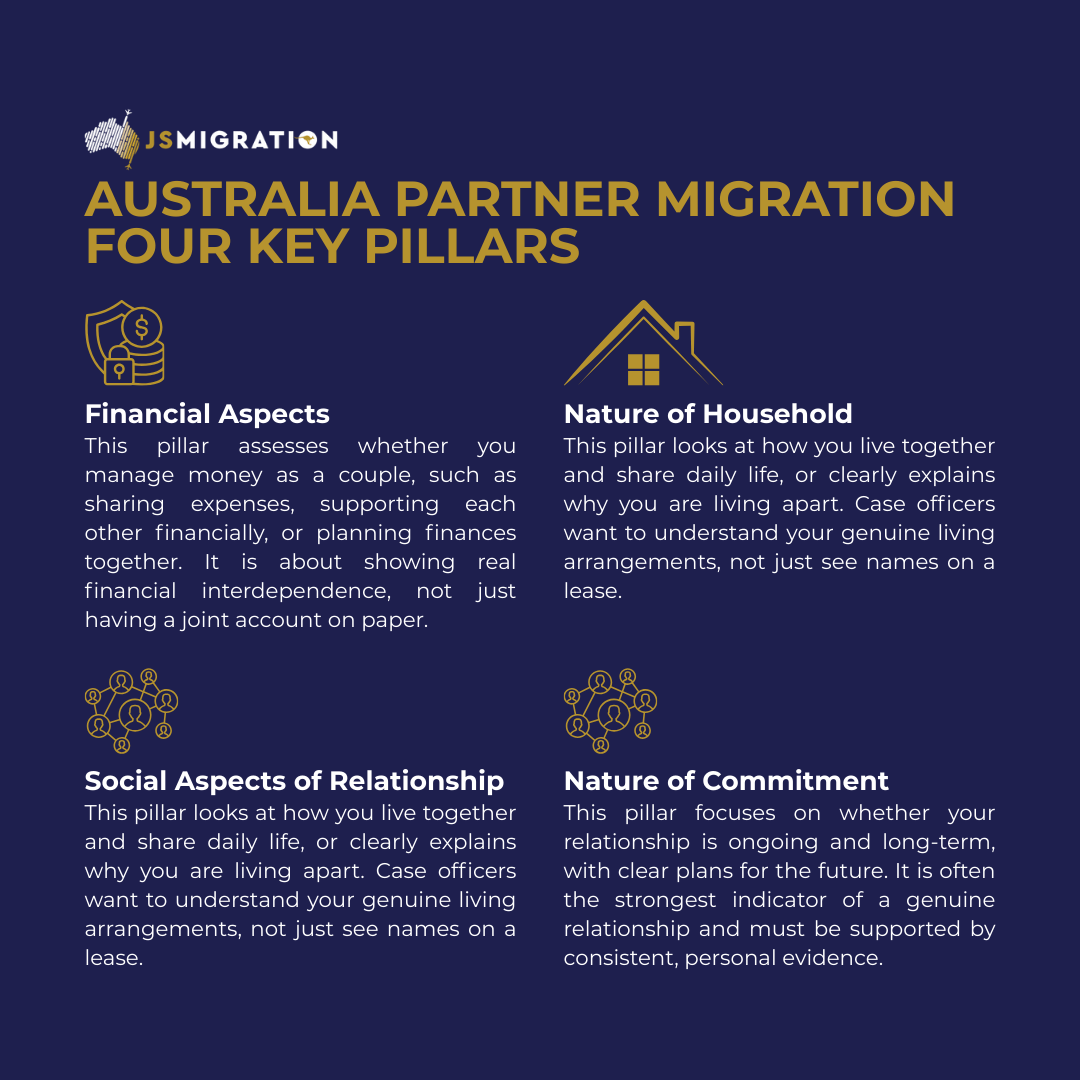
Let us break them down for you.
Financial Aspects of the Relationship
This pillar looks at how you manage money together. Examples of strong evidence include:
- Joint bank accounts actively used
- Shared bills (rent, utilities, internet)
- Evidence of financial support between partners
- Shared assets or liabilities
What case officers are not looking for:
- A joint account opened last week with no activity
- Dozens of personal bank statements with no explanation
- Cash transfers without context
Same-Sex Couples: What If You Cannot Combine Finances?
For some same-sex couples, joint finances may not be possible due to:
- Safety concerns
- Cultural or family pressures
- Living in different countries
This does not automatically weaken your case. What matters is:
- Explaining why finances are separate
- Showing alternative financial support or shared financial planning
- Providing statements that clearly address your situation
Nature of the Household
This pillar examines how you live together — or why you don’t. Strong evidence includes:
- Joint lease or property ownership
- Shared address history
- Mail addressed to both partners
- Statements explaining household roles
Living together is important, but not mandatory if you can show:
- Genuine reasons for living apart
- Ongoing commitment despite distance
Common Mistake
Many applicants submit:
- A lease with both names, but no proof of actually living together
- No explanation of who does what in the household
Case officers want to understand the reality of your living arrangements, not just paperwork.
Social Aspects of the Relationship
This pillar shows whether your relationship is known to others.
Evidence may include:
- Photos with family and friends
- Invitations or joint event attendance
- Messages or posts showing social recognition
- Statutory declarations from friends or relatives
Same-Sex Couples: Social Evidence Can Look Different
Not all same-sex couples can be open about their relationship, especially with:
- Family members
- Employers
- Communities in certain countries
This is understood under Australian law.
What matters is:
- Being honest about who knows and who doesn’t
- Explaining any safety or cultural concerns
- Providing alternative evidence where possible
Attempting to pretend openness where it does not exist is far more damaging than explaining the truth.
Nature of Commitment to Each Other
This is often the most important pillar. Case officers assess:
- Length of the relationship
- Intentions for the future
- Emotional support
- Evidence of long-term planning
Strong evidence includes:
- Statements describing how the relationship developed
- Plans for living together permanently
- Evidence of ongoing contact during separation
- Wills, beneficiaries, or long-term commitments
A Key Point for 2025
Generic relationship statements are no longer effective.
Statements must be:
- Personal
- Chronological
- Consistent with other evidence
If your story does not line up across documents, doubts arise quickly.
The Most Common Evidence Mistakes Case Officers See
Here are the issues that most often lead to refusals:
- No Clear Relationship Timeline — Applicants submit documents but fail to explain:
- When the relationship started
- How it progressed
- When key milestones occurred
- Contradictions Between Forms and Statements — Even small inconsistencies can raise serious concerns.
- Over-Reliance on Photos — Photos help; but they do not prove commitment on their own.
- Ignoring Weak Areas — Some couples avoid addressing gaps instead of explaining them. Silence creates suspicion.
How Much Evidence Is “Enough” in 2025?
While there are no fixed number of evidence required, a well-prepared application usually includes:
- Clear statements from both partners
- Balanced evidence across all four pillars
- Evidence covering the entire relationship period
- Explanations for any gaps or limitations
“Enough” means:
- The case officer can understand your relationship without guessing
- Your evidence tells a clear, consistent story
- Your circumstances are explained honestly
How to Present Evidence Strategically
Presentation matters almost as much as the evidence itself.
Strong applications:
- Group evidence by pillar
- Label documents clearly
- Provide short explanations for key items
- Avoid irrelevant or duplicate material
Think of your application as a guided walkthrough, not a document dump.
Every Relationship Is Different — But the Law Is Clear
Australian migration law does not expect perfect relationships. It expects genuine ones.
Same-sex couples are equally protected, equally assessed, and equally eligible — but like all applicants, success depends on how well the relationship is explained and evidenced.
A well-prepared partner visa application is not about proving love. It is about proving commitment, consistency, and credibility.
Ready to take the next step? Now is the perfect time to get expert guidance. The 2025 migration changes don’t have to feel overwhelming. Our team is here to simplify the process, assess your eligibility, and help you present a strong, confident partner visa application.
Unsure if your relationship evidence is “enough”?
Partner visa refusals often come down to how **evidence is presented — not whether the relationship is genuine. Our experienced migration team can review your situation, identify gaps, and guide you on how to prepare clear, credible evidence that meets current Department expectations.
Book a consultation with us today and move forward with confidence, supported by an experienced and LGBTQ+-affirming Australian migration professional who understands the realities behind every relationship.
POSTED: 19 Dec, 2025
View all news