
Why Comparing Your Australian Visa Journey to Others Does More Harm Than Good

If you are on an Australian visa journey, chances are you have heard someone say this:

“My friend got approved in just three months.”
“Someone I know applied later than me and already got their visa.”
“Why is mine taking so long when we have the same occupation?”

In today’s world of Facebook groups, TikTok reels, and migration forums, it is almost impossible not to compare your visa journey to others. Every scroll seems to show a new approval post, a timeline breakdown, or a success story — often without the full picture.

While these stories can feel motivating at first, comparison is one of the biggest causes of stress, rushed decisions, and avoidable mistakes in Australian migration.

The truth is simple but often hard to accept:

Different visa timelines do not mean unfair treatment — and they definitely do not mean you are failing.

This article takes a soft yet realistic look at why comparing your Australian visa journey to others can do more harm than good, and how focusing on your own pathway leads to better outcomes.

Social Media Has Changed How Migrants Experience the Visa Process

Migration used to be a private, paperwork-heavy process. Today, it is public.

Applicants openly share:

  • Visa grant screenshots
  • Processing times
  • Lodgement dates
  • Step-by-step “how I got my PR” stories

While transparency can be helpful, it also creates a false sense of comparison.

Most online posts only show the outcome, not:

  • The refusals before approval
  • The years of temporary visas
  • The incorrect advice that delayed them
  • The personal circumstances that sped things up

When you compare your visa application to someone else’s highlight reel, you are rarely comparing the full story.

Different Timelines Do Not Mean Unfair Treatment

One of the most common assumptions migrants make is that similar profiles should result in similar outcomes. But in Australian immigration, no two cases are truly the same.

Even if two applicants share:

  • The same occupation
  • The same visa subclass
  • The same country of origin

Their timelines can still differ significantly due to:

  • Skills assessment processing times
  • Completeness of documents
  • Health or character checks
  • Employer readiness (for sponsored visas)
  • State or regional nomination cycles

A longer wait does not automatically mean something is wrong. In many cases, it simply means your application has different moving parts.

“My Friend Got Approved in 3 Months”

This sentence causes more anxiety than almost any other phrase in migration conversations.

Here is the reality:

Your friend’s approval timeline is not a standard, and it is rarely repeatable.

What is often missing from these stories:

  • Was it onshore or offshore?
  • Was priority processing involved?
  • Did they apply during a low-volume period?
  • Was their application decision-ready from day one?

Without context, timelines shared online become dangerous benchmarks.

When applicants treat someone else’s timeline as a promise, they often:

  • Panic when their case moves slower
  • Assume something is wrong without evidence
  • Make rushed decisions to “catch up”

How Comparison Leads to Rushed and Risky Decisions

Comparison anxiety doesn’t just affect emotions — it affects decisions.

When migrants feel “behind,” they are more likely to:

  • Lodge applications before they are fully prepared
  • Switch visa strategies mid-process
  • Ignore professional advice in favour of online opinions
  • Choose speed over suitability

In Australian migration, rushing is one of the most expensive mistakes you can make.

A delayed application can be frustrating.

A refused application can change your entire future.

The Pressure to “Keep Up” Is Not a Migration Strategy

Many migrants feel an unspoken pressure to:

  • Apply by a certain age
  • Secure PR within a set number of years
  • Match the progress of friends or colleagues

But migration is not a race.

Some people reach permanent residency quickly.

Others take longer but arrive with:

  • Stronger employment history
  • Better long-term stability
  • Clearer settlement plans

Progress looks different for everyone. The goal is not to be fast — it is to be sustainable.

What You Don’t See Behind Most Success Stories

Success stories are real — but they are often incomplete.

Behind many “approved” posts are:

  • Multiple temporary visas
  • Strategy changes along the way
  • Periods of uncertainty and waiting
  • Professional guidance that isn’t mentioned

When migrants compare their beginning to someone else’s ending, they miss the most important part:

the journey in between.

Focusing on Your Own Australian Visa Pathway

The most successful migrants are not the ones who compare the least — they are the ones who refocus the fastest.

A healthier approach is to ask:

  • Is my current visa pathway suitable for my background?
  • Am I meeting requirements as they apply to me?
  • Have I planned for delays, not just best-case timelines?

When you focus on your own pathway:

  • Decisions become clearer
  • Anxiety becomes manageable
  • Planning becomes proactive instead of reactive

Why Patience Is Not Passive in Migration

Waiting is often mistaken for doing nothing.

In reality, waiting periods are when smart migrants:

  • Improve English scores
  • Strengthen work experience
  • Prepare future applications
  • Build career stability in Australia

Patience, when paired with planning, is an active strategy — not a weakness.

A Realistic Reminder for Anyone on a Visa Journey

If you are currently waiting, delayed, or feeling left behind, remember this:

  • A slower timeline does not mean failure
  • Someone else’s approval does not reduce your chances
  • Rushing rarely leads to better outcomes
  • Your visa journey is not meant to look like anyone else’s

Australian immigration is complex, personal, and constantly evolving. Comparing your case to others oversimplifies a process that deserves careful, individual planning.

Stay Informed, Not Influenced

It is okay to seek information. It is okay to feel encouraged by success stories. But when comparison starts driving fear, pressure, or rushed decisions, it stops being helpful. The most important migration strategy you can have is this:

Understand your own situation, plan realistically, and move forward at the pace your pathway requires. Because in Australian migration, the biggest mistake is not waiting — it is letting comparison push you into the wrong decision.

If you’re feeling uncertain or overwhelmed by your Australian visa journey, you don’t have to navigate it alone. Getting the right advice at the right time can help you focus on a pathway that suits your situation — not someone else’s timeline. Speak with a migration professional to gain clarity, plan with confidence, and move forward without unnecessary stress.

Is 2026 the Right Year to Apply for Permanent Residency in Australia?

Deciding whether to apply for Permanent Residency (PR) in Australia is a major life choice — one that affects your future, your family’s stability, and your long-term plans. As we enter 2026, many temporary visa holders (students, skilled workers, families, and others) are asking the same question: Is this the right time to take the next step towards PR?

This article breaks down the most important factors in a clear, authoritative, and non-pushy way. We’ll look at policy settings, visa pathways, recent trends, and practical considerations that will help you make a confident, informed decision.

What is Permanent Residency (PR)?

Permanent Residency in Australia allows individuals to:

  • Live indefinitely in the country,
  • Work and study freely,
  • Access Medicare and other government services, and
  • Eventually pursue Australian citizenship if eligible.

This status is typically the goal of many temporary visa holders who seek longer-term stability in Australia. The Department of Home Affairs explains that PR opens doors to broader opportunities while offering many of the same rights as citizens (except voting) once granted.

Australia’s 2025–26 Permanent Migration Program: What’s Confirmed

For the 2025–26 migration year, the Australian Government has set the Permanent Migration Program at 185,000 places, the same number as the previous year. This includes allocations across different streams such as skilled, family, and special eligibility visas.

Key breakdown (approximate):

  • Skill stream visas: ~132,200 places (~71%)
  • Family stream visas: ~52,500 places (~28%)
  • Special Eligibility: ~300 places (<1%)

Stable planning levels can be reassuring for applicants — they signal predictability in overall visa quotas rather than unexpected cuts or major policy shifts at the start of the year.

What this means for applicants:

  • There’s no sudden reduction in overall visa places early in 2026.
  • Many priority settings from previous years remain intact, giving applicants a baseline expectation of opportunities.

Pathways to Permanent Residency

Australia offers several pathways to PR — each with its own eligibility criteria and strategic considerations. Understanding these options is essential before deciding whether 2026 is the right time to apply.

Skilled Migration

The skilled migration pathway is a common route for those with occupations in demand, assessed through a points system.

Some key visa subclasses include:

  • Subclass 189 — Skilled Independent visa (points-tested, no sponsorship needed),
  • Subclass 190 — Skilled Nominated visa (state or territory nomination),
  • Subclass 491/494 leading to Subclass 191 — Regional skilled visas with eventual PR options.

In the current planning levels, skilled visas dominate the program, reflecting Australia’s ongoing need for skilled professionals.

Employer-Sponsored Visas

These visas require an Australian employer nomination and include:

  • Subclass 186 (ENS) — Permanent employer-sponsored visa,
  • Temporary visas (e.g., subclass 482) that can transition to PR via subclass 186.

Data from recent reports shows employer-sponsored routes remain the most successful for many skilled migrants, especially those already working in Australia.

Family Stream Visas

Partner and family pathways continue to form a significant part of the migration program, especially partner visas. These visas are demand-driven within the planning levels, meaning processing reflects real-time applicant numbers rather than fixed allocations.

New & Emerging Pathways

The Government’s migration planning includes new categories such as the National Innovation Visa, which consolidates talent-based entries and focuses on individuals with exceptional skills or innovation potential.

Factors to Consider Before Applying in 2026

Your Personal & Professional Readiness

No policy setting can replace the significance of personal readiness. Ask yourself:

  • Do you meet the points test (if applicable)?
  • Do you have a skills assessment in your occupation?
  • Are your English language scores competitive?
  • Is your age favorable within the points system?

Improvements in these areas can greatly affect your chances of PR invitation or approval.

Practical tip: Starting with a skills and points assessment early in 2026 can help you decide if applying now makes sense or if a bit more preparation is worthwhile.

Work & Sponsorship Opportunities

If you are already working in Australia or have an employer willing to sponsor you, early action in 2026 could be beneficial.

Employer sponsorship pathways — especially subclass 186 — have shown strong results in recent years, and data suggests they remain one of the most dependable routes to PR.

Occupation Demand and Regional Incentives

Certain professions — particularly in healthcare, engineering, IT, and regional sectors — continue to be in higher demand. Regional pathways also offer additional incentives (e.g., extra points, targeted processing) for those willing to live and work outside major cities.

Visa Processing Times & System Backlogs

Visa processing times vary. Applicants should be aware that:

  • Some visa categories may take several months to be finalised.
  • Temporary visa holders should ensure they maintain lawful status while waiting for a decision.

Processing can fluctuate throughout the year, but consistent planning levels help stabilise expectations.

Is Now Better Than Later? A Balanced View

There’s no universal “best time” to apply — it depends on your individual profile and readiness. But 2026 presents certain features that support thoughtful decision-making:

✔ Stability in Migration Program Settings

With the permanent program maintained at 185,000 places and no abrupt policy shifts announced at the start of the year, applicants have a relatively predictable backdrop.

✔ Continued Focus on Skilled Migration

Skilled pathways remain central to the migration program — and many occupations in demand still qualify under the points system or employer sponsorship categories. VisaAdvisor

✔ More Data Available for Planning

By early 2026, applicants can draw on recent reports and trends from the prior year (2025 reporting), giving a clearer picture of which pathways showed the strongest outcomes.

However: If you are close to meeting eligibility criteria (e.g., waiting on a skills assessment, close to required work experience, or aiming to improve English scores), taking a little extra time early in the year to strengthen your profile may ultimately be more strategic than rushing an application.

Key Takeaways

2026 is a practical time to review your Permanent Residency options — not because the process is easier, but because Australia’s migration settings remain relatively stable at the start of the year.

  • Stable planning levels provide clearer expectations for PR applicants.
  • Skilled and employer-sponsored pathways continue to be key routes to permanent residency.
  • Personal readiness matters, from skills assessments to English results and documentation.
  • Good timing is strategic — applying when you’re ready often leads to stronger outcomes.

Permanent Residency is a long-term decision, not a rushed one. Starting 2026 with a clear understanding of your options can help you move forward with confidence.

If you’d like clarity on where you stand, you’re welcome to contact our team for a personalised discussion about your PR options — whenever you’re ready.

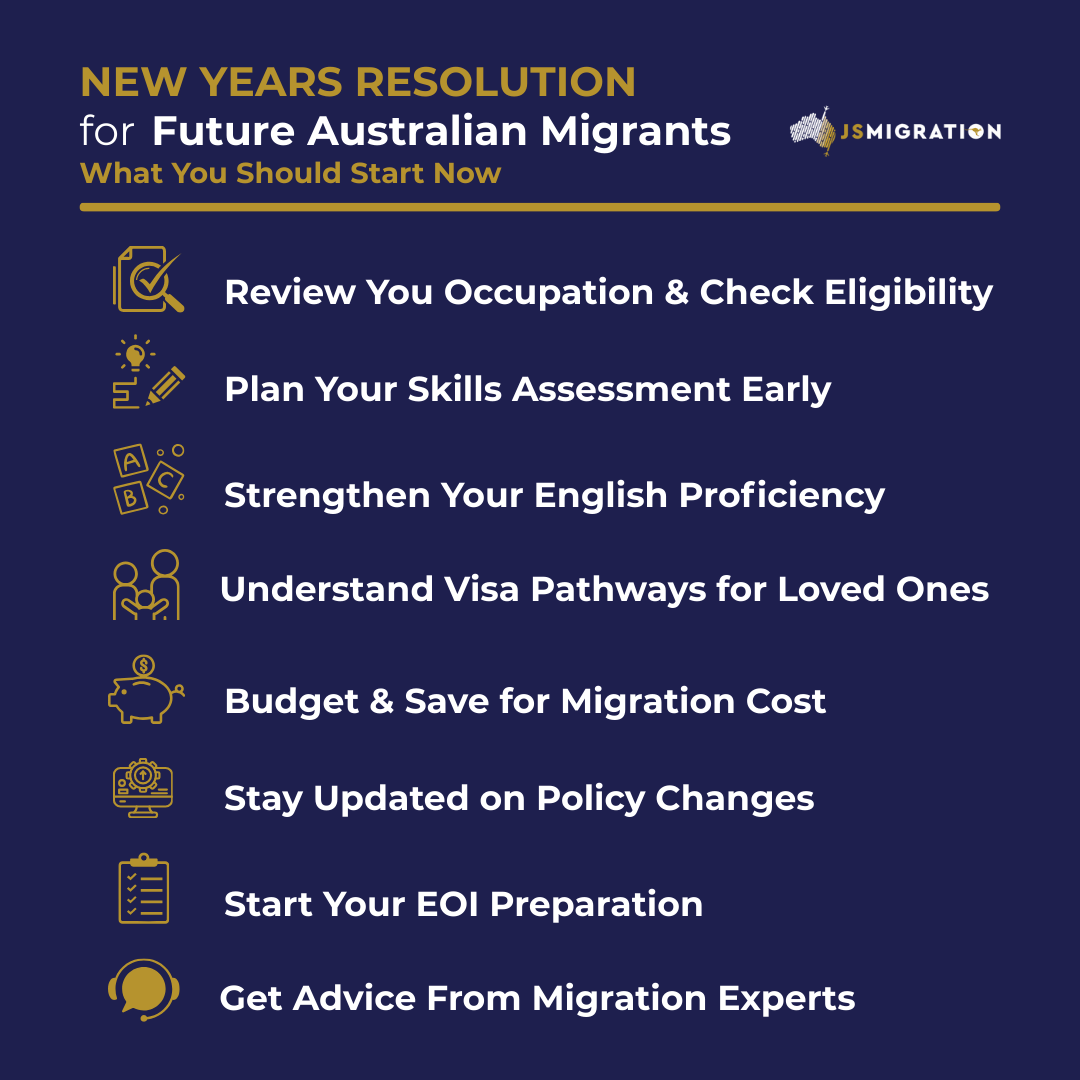
New Year Resolutions for Future Australian Migrants: Start Your Journey Now

The start of a new year is the perfect time to set goals and make plans — and if migrating to Australia is on your list, now is the moment to act. Planning ahead can save months, or even years, of delays and ensure a smoother path for you and your loved ones. From understanding visa options to preparing your skills and finances, this guide will outline practical steps every aspiring migrant should take in 2026.

Review Your Occupation and Check Eligibility

The first step for any migration plan is knowing whether your profession qualifies for Australian visas.

  • Skilled Occupation Lists: The Medium and Long-Term Strategic Skills List (MLTSSL) and Short-Term Skilled Occupation List (STSOL) identify occupations in demand.
  • Why it matters: If your occupation isn’t listed, certain visa options may not be available.

Actionable Tip: Research your occupation’s eligibility and note any additional requirements for licensing or registration in Australia.

Plan Your Skills Assessment Early

Skills assessments are mandatory for most skilled visas. They verify that your qualifications and work experience meet Australian standards.

  • Timing matters: Processing can take several months.
  • Preparation: Ensure your documents, employment references, and educational credentials are complete and accurate.

Actionable Tip: Contact the relevant assessing authority and schedule your assessment as early as possible to avoid delays later in your migration journey.

Strengthen Your English Language Proficiency

English proficiency is crucial for both your visa application and your eventual integration into Australian life.

  • Accepted tests: IELTS, PTE, or TOEFL.
  • Tips: Start preparing early, practice regularly, and consider professional courses if needed.

Actionable Tip: Aim to take your English test at least six months before submitting your visa application to give yourself enough time to retake it if needed.

Understand Visa Pathways for Bringing Loved Ones

Many aspiring migrants want to bring family members with them. Planning early is key:

  • Partner and dependent visas: Understand eligibility and documentation requirements.
  • Impact on points-based visas: Some visas consider family members in the points system, so planning can maximize your score.

Actionable Tip: Make a list of family members you want to include in your application and gather their documents early.

Budget and Save for Migration Costs

Migration involves costs beyond the visa application, such as:

  • Skills assessment fees
  • English test fees
  • Visa application charges
  • Medical and police checks
  • Relocation expenses

Actionable Tip: Create a dedicated migration fund to avoid financial stress later in the process.

Stay Updated on Policy Changes

Australia’s immigration rules can change year to year. Staying informed ensures you don’t miss new opportunities or face unexpected hurdles.

  • Reliable sources: Government websites, reputable migration agencies, and newsletters.

Actionable Tip: Make it a habit to check updates monthly, especially regarding skilled migration quotas and visa processing times.

Start Your Expression of Interest (EOI) Preparation

For points-based visas, the EOI is your first formal step in expressing your intent to migrate.

  • Key components: Points calculation, skills, work experience, English proficiency, and family details.
  • Strategy: Prepare your EOI carefully to maximize points and improve chances of receiving an invitation.

Actionable Tip: Gather all supporting documents and update them regularly to reflect your latest achievements and experience.

Consider Professional Advice from Migration Experts

Migration can be complex. Consulting an experienced migration agency like JS Migration ensures that your plan is realistic, documents are correct, and timelines are optimized.

  • Benefits: Avoid mistakes, maximize points, and receive personalized advice for your situation.

Actionable Tip: Schedule a consultation early in the year to map out your complete migration strategy.

Starting your Australian migration journey early in the year increases your chances of success and helps you manage the process smoothly. By reviewing your occupation, completing skills assessments, preparing for English tests, budgeting wisely, and seeking expert advice, you set yourself and your loved ones up for a brighter future in Australia. Make 2026 the year you turn your migration goals into reality.

Ready to make your Australian migration dream a reality? At JS Migration, our expert team can guide you through every step — from visa selection to skills assessments and family inclusion. Reach out to us today and start your 2026 migration journey with confidence!