What Happens to Australian Visa Processing Over the Holidays? What Applicants Should Know

The holiday season is a time for reflection, rest, and spending meaningful moments with loved ones. For many people planning or already navigating their Australian migration journey, however, this period can also bring questions and uncertainty — particularly around visa processing timelines.

If you’ve lodged a visa application, are preparing documents, or are considering starting your Australian migration journey, you may be wondering:

Does visa processing stop during the holidays? Will my application be delayed? Should I wait until the new year?

The good news is that while the holiday period does bring some seasonal slowdowns, Australian migration processes continue to move forward. Understanding what typically happens during this time can help you manage expectations, reduce stress, and make informed decisions — all while enjoying the holiday season with peace of mind.

This article explains what applicants should realistically expect when it comes to Australian visa processing over the holidays, and how to use this time wisely and positively.

Understanding the Holiday Period in Australian Immigration

In Australia, the main holiday period generally runs from mid-December through early January, covering Christmas, Boxing Day, New Year’s Eve, and New Year’s Day. During this time, many government offices operate with reduced staffing, as public servants take scheduled leave.

Importantly, this does not mean that visa processing completely stops. Instead, processing continues at a slower pace, with fewer case officers available to assess applications, request additional information, or finalise decisions.

This seasonal slowdown is expected and occurs every year. Knowing this in advance allows applicants to adjust their expectations and avoid unnecessary worry.

Does Australian Visa Processing Stop Over the Holidays?

The short answer is no — Australian visa processing does not fully stop during the holidays.

However, applicants should be aware of a few key realities:

  • Processing continues, but at reduced capacity
  • Response times may be longer than usual
  • Decisions may take additional weeks, depending on visa type and complexity
  • Requests for further information may pause temporarily

Many visa applications are assessed by teams rather than individual officers, and some systems continue running even when staffing levels are lower. Automated systems, internal workflows, and queue management remain active.

That said, the holiday period is not the time to expect rapid updates or quick outcomes — and that’s completely normal.

Which Visa Types Are Most Affected?

While all visa categories may experience slight delays during the holiday season, some are more affected than others.

Skilled Migration Visas

Skilled visas, such as:

  • Skilled Independent (Subclass 189)
  • Skilled Nominated (Subclass 190)
  • Skilled Work Regional (Subclass 491)

often involve multiple stages, including skills assessments, state nominations, and departmental processing. During the holidays, these steps may continue, but approvals and requests may be slower.

Partner and Family Visas

Partner and family visas are typically longer-term applications with broader processing windows. As a result, a short holiday slowdown usually has minimal impact on overall timelines.

Applicants should not be alarmed if there is no movement during December or early January — this is expected.

Student and Temporary Visas

Processing for student and temporary visas may still occur, particularly where timelines are linked to intake dates or employment needs. However, applicants should still expect some seasonal delays.

What About Applications Already Lodged?

If you have already lodged your visa application, the most important thing to remember is this:

A lack of updates during the holidays does not mean something is wrong.

It simply means your application remains in the processing queue.

During this period:

  • Applications remain valid and active
  • Documents already submitted continue to be reviewed
  • Your place in the processing order is not affected

In most cases, activity resumes more visibly from mid to late January, when staffing levels return to normal.

Should You Lodge an Application During the Holidays?

Yes — in many cases, lodging during the holiday period can still be beneficial.

While processing may be slower initially, lodging earlier can:

  • Secure your place in the processing queue
  • Allow your application to be ready for assessment once operations resume fully
  • Prevent unnecessary delays caused by waiting until the new year

For applicants who already have their documents prepared, there is no requirement to pause plans simply because it is the holiday season.

That said, accuracy and completeness are far more important than speed. Submitting a well-prepared application is always better than rushing to lodge before year-end.

How the Holidays Can Be a Smart Planning Period

Even if you choose not to lodge an application immediately, the holiday season can be an excellent time for preparation.

Many applicants use this quieter period to:

  • Review eligibility criteria
  • Organise documents
  • Book skills assessments or English tests
  • Discuss migration plans with family members
  • Seek professional advice without pressure

Without the usual work and life demands, applicants often have more mental space to think clearly about long-term goals — including Australian migration.

Managing Expectations: A Healthier Approach

One of the most valuable things applicants can do during the holiday period is to reset expectations.

Australian migration is not an instant process. It requires patience, preparation, and trust in the system. A short seasonal slowdown does not derail well-planned applications or reduce approval chances.

Rather than focusing on timelines you cannot control, it is far more productive to focus on:

  • Document readiness
  • Clear migration pathways
  • Long-term eligibility
  • Professional guidance

This mindset helps reduce stress and keeps your migration journey sustainable and positive.

What Happens After the Holidays?

Once the holiday period ends and normal operations resume:

  • Case officers return to full capacity
  • Pending applications begin moving again
  • Requests for information and decisions gradually increase
  • Processing timelines stabilise

For many applicants, January and February mark a return to visible progress — particularly for applications lodged in the months prior.

This is why preparation done during the holidays often pays off early in the new year.

How Professional Support Helps During This Time

Navigating migration timelines can be confusing, especially during seasonal slowdowns. Working with a registered migration professional helps ensure that:

  • Your application remains compliant and accurate
  • Documents are complete before submission
  • Expectations are set realistically
  • Communication with the Department is handled properly

Professional guidance also removes the guesswork, allowing you to enjoy the holiday season without constantly worrying about your visa status.

If you are waiting for an update, preparing an application, or simply considering Australian migration, the holiday season is not a setback — it is a pause, not a stop. Visa processing continues, plans remain valid, and opportunities are still very much ahead. Take this time to reflect, prepare, and rest. Australian migration is a journey, and every well-considered step — even during the holidays — brings you closer to your goal. Talk to us today!
Relationship Evidence in Australia Partner Visas: How Much Is “Enough” in 2025?

Applying for an Australian Partner Visa is not just about proving that you love each other — it is about proving that your relationship is genuine, ongoing, and committed in a way that Australian migration law recognises.

In 2025, many partner visa refusals happen not because the relationship is fake, but because the evidence is poorly prepared. Some applicants submit too little. Others submit hundreds of pages with no structure. Both approaches can lead to refusal.

On our article today, we will aim to share:

  • How the Department of Home Affairs assesses relationship evidence
  • What “enough” evidence really means in 2025
  • The four key pillars case officers look at
  • Common mistakes that lead to refusals
  • How same-sex couples are assessed (and protected) under Australian law
  • How to present evidence clearly and strategically

Now let us start by highlighting an important factor that might sound controversial for a lot of people: partner sponsorship for same-sex couples.

First Things First: Same-Sex Couples Are Treated Equally

We will be direct to the point on this matter. Australian migration law fully recognises same-sex relationships. There are no separate visa category, no higher evidence threshold, and no different legal test. Same-sex and opposite-sex couples are assessed under exactly the same Partner Visa criteria.

What might differ, however, is how evidence is available, especially for couples who:

  • Come from countries where same-sex relationships are not legally recognised
  • Cannot live together openly
  • Cannot marry or register their relationship

The key is explaining your circumstances clearly and supporting them with appropriate evidence. If you need help, please do not hesitate to reach out and we will be very happy to help.

The Biggest Myth: “More Evidence Is Always Better”

One of the most damaging assumptions applicants make is believing that volume equals strength. In reality:

  • 30 well-chosen documents explained properly can be stronger than 300 random files
  • Case officers do not have time to “figure out your story”
  • Unorganised evidence can raise doubts rather than resolve them

In 2025, decision-makers are looking for clarity, consistency, and credibility — not data overload.

How Case Officers Assess Relationships

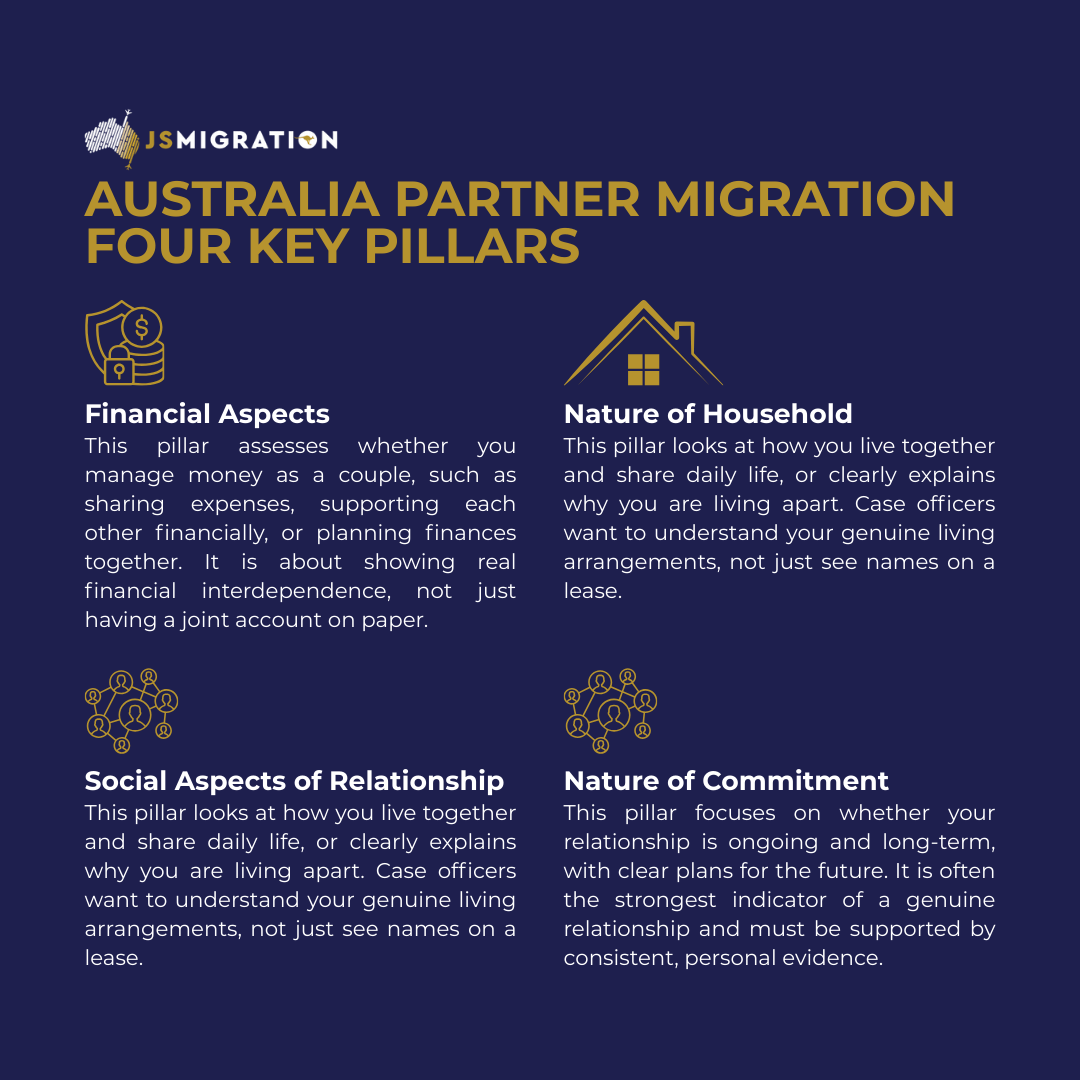
The Department assesses relationships using four key pillars. Every partner visa application must address all four. If one pillar is weak or missing, the entire application is at risk.

Australia Partner Migration - Four Key Pillars to prove your relationship

Let us break them down for you.

Financial Aspects of the Relationship

This pillar looks at how you manage money together. Examples of strong evidence include:

  • Joint bank accounts actively used
  • Shared bills (rent, utilities, internet)
  • Evidence of financial support between partners
  • Shared assets or liabilities

What case officers are not looking for:

  • A joint account opened last week with no activity
  • Dozens of personal bank statements with no explanation
  • Cash transfers without context

Same-Sex Couples: What If You Cannot Combine Finances?

For some same-sex couples, joint finances may not be possible due to:

  • Safety concerns
  • Cultural or family pressures
  • Living in different countries

This does not automatically weaken your case. What matters is:

  • Explaining why finances are separate
  • Showing alternative financial support or shared financial planning
  • Providing statements that clearly address your situation

Nature of the Household

This pillar examines how you live together — or why you don’t. Strong evidence includes:

  • Joint lease or property ownership
  • Shared address history
  • Mail addressed to both partners
  • Statements explaining household roles

Living together is important, but not mandatory if you can show:

  • Genuine reasons for living apart
  • Ongoing commitment despite distance

Common Mistake

Many applicants submit:

  • A lease with both names, but no proof of actually living together
  • No explanation of who does what in the household

Case officers want to understand the reality of your living arrangements, not just paperwork.

Social Aspects of the Relationship

This pillar shows whether your relationship is known to others.

Evidence may include:

  • Photos with family and friends
  • Invitations or joint event attendance
  • Messages or posts showing social recognition
  • Statutory declarations from friends or relatives

Same-Sex Couples: Social Evidence Can Look Different

Not all same-sex couples can be open about their relationship, especially with:

  • Family members
  • Employers
  • Communities in certain countries

This is understood under Australian law.

What matters is:

  • Being honest about who knows and who doesn’t
  • Explaining any safety or cultural concerns
  • Providing alternative evidence where possible

Attempting to pretend openness where it does not exist is far more damaging than explaining the truth.

Nature of Commitment to Each Other

This is often the most important pillar. Case officers assess:

  • Length of the relationship
  • Intentions for the future
  • Emotional support
  • Evidence of long-term planning

Strong evidence includes:

  • Statements describing how the relationship developed
  • Plans for living together permanently
  • Evidence of ongoing contact during separation
  • Wills, beneficiaries, or long-term commitments

A Key Point for 2025

Generic relationship statements are no longer effective.

Statements must be:

  • Personal
  • Chronological
  • Consistent with other evidence

If your story does not line up across documents, doubts arise quickly.

The Most Common Evidence Mistakes Case Officers See

Here are the issues that most often lead to refusals:

  • No Clear Relationship Timeline — Applicants submit documents but fail to explain:
    • When the relationship started
    • How it progressed
    • When key milestones occurred
  • Contradictions Between Forms and Statements — Even small inconsistencies can raise serious concerns.
  • Over-Reliance on Photos — Photos help; but they do not prove commitment on their own.
  • Ignoring Weak Areas — Some couples avoid addressing gaps instead of explaining them. Silence creates suspicion.

How Much Evidence Is “Enough” in 2025?

While there are no fixed number of evidence required, a well-prepared application usually includes:

  • Clear statements from both partners
  • Balanced evidence across all four pillars
  • Evidence covering the entire relationship period
  • Explanations for any gaps or limitations

“Enough” means:

  • The case officer can understand your relationship without guessing
  • Your evidence tells a clear, consistent story
  • Your circumstances are explained honestly

How to Present Evidence Strategically

Presentation matters almost as much as the evidence itself.

Strong applications:

  • Group evidence by pillar
  • Label documents clearly
  • Provide short explanations for key items
  • Avoid irrelevant or duplicate material

Think of your application as a guided walkthrough, not a document dump.

Every Relationship Is Different — But the Law Is Clear

Australian migration law does not expect perfect relationships. It expects genuine ones.

Same-sex couples are equally protected, equally assessed, and equally eligible — but like all applicants, success depends on how well the relationship is explained and evidenced.

A well-prepared partner visa application is not about proving love. It is about proving commitment, consistency, and credibility.

Ready to take the next step? Now is the perfect time to get expert guidance. The 2025 migration changes don’t have to feel overwhelming. Our team is here to simplify the process, assess your eligibility, and help you present a strong, confident partner visa application.

Unsure if your relationship evidence is “enough”?

Partner visa refusals often come down to how **evidence is presented — not whether the relationship is genuine. Our experienced migration team can review your situation, identify gaps, and guide you on how to prepare clear, credible evidence that meets current Department expectations.

Book a consultation with us today and move forward with confidence, supported by an experienced and LGBTQ+-affirming Australian migration professional who understands the realities behind every relationship.

Australia’s 2025 Partner Visa Changes: A Guide for Same-Sex Couples Navigating Migration

Even as Australia’s immigration landscape undergoes significant changes, with many avenues becoming more restrictive, the Partner Visa stands out as a consistent option. For same-sex couples, this visa offers more than just a way to immigrate; it provides crucial validation. It legally acknowledges their relationship as equal.

The Australian government’s Migration Reset, slated for 2025, prioritizes the integrity of the entire system. This includes stricter verification, and a more controlled intake of migrants. Skilled worker visas and temporary programs are updating quickly. Student visa options are also changing, and employers are adapting to new regulations.

Despite these widespread adjustments, the Partner Visa remains a reliable and constant option.

For same-sex couples looking to build a life in Australia, the visa pathway is not only available but also fully supported and protected. Australia recognizis their relationships with complete equality. However, new policies influence how applications are processed, and staying informed about these changes is key for couples to prepare effectively.

A Clear Pathway in a Changing System

Case officers now take a more holistic, attentive approach to each relationship story, spending more time understanding the genuine nature of a partnership. For same-sex couples, this isn’t a barrier — it’s an opportunity to present your relationship in your own words, to demonstrate your plans together, to show how your lives, values, and futures align. The system isn’t looking for perfection. It’s looking for authenticity.

One of the biggest shifts in 2025 is the deeper level of engagement from case officers. For many LGBTQ+ couples, this actually works in your favour. Australia’s migration framework does not expect relationships to look a single way — it recognises diversity in how couples build lives together. Whether you’ve lived together for years or maintained a cross-border relationship, what matters is the clarity of your story and your long-term commitment to each other.

Navigating Onshore and Offshore Pathways

The balance between onshore and offshore partner visa processing has also shifted subtly in 2025. Onshore applications remain popular for couples already building their life in Australia. It offers a bridging visa, work rights, access to Medicare, and freedom to stay together while waiting for the application results. Meanwhile, offshore applications continue to move steadily once assigned, making them a strong choice for couples currently living in different countries or managing international careers.

There’s no “better” option. There’s only the option that best supports the rhythm of your relationship.


One of the most powerful aspects of Australia’s Partner Visa program is its unwavering commitment to equality. Australia fully and proudly recognize same-sex relationships—whether you’re married, in a de facto partnership, or regardless of your home country’s laws.

This inclusivity isn’t symbolic — it has real, practical effects:

  • Your application is assessed on the same terms as any other couple.
  • Your evidence is valued with the same standards and respect.
  • Your future together in Australia is supported by a legal system built on fairness.

The Partner Visa program remains one of Australia’s strongest demonstrations of its commitment to LGBTQ+ rights — and that commitment holds firm in 2025.

Understanding This Year’s Challenges — Without Fear

Partner visas in 2025 come with higher expectations for clarity, consistency, and supporting documents. This applies to all couples, regardless of gender or orientation. What’s different this year is simply the depth of review.

  • Case officers want to understand the story behind the evidence, not just collect documents.
  • Strong applications are less about volume and more about intention:
    • Your shared plans
    • Your shared home
    • Your shared journey.

A well-presented relationship history, thoughtful statements, and organised documents continue to be the backbone of a smooth application.

For Same-Sex Couples, 2025 Is a Year of Stability and Opportunity

Even with the Migration Reset reshaping much of Australia’s visa framework, the Partner Visa remains one of the most reliable, inclusive, and relationship-focused pathways. Australia continues to recognise LGBTQ+ couples with full legal equality.

  • Your relationship is protected.
  • Your application is welcomed.
  • Your future together is supported by a system that sees and values your commitment.

Australia’s 2025 migration program keeps the outlook bright for same-sex couples. Grounded in fairness, strengthened by equality, and centered on families.


Ready to take the next step? Now is the perfect time to get expert guidance. The 2025 migration changes don’t have to feel overwhelming. Our team is here to simplify the process, assess your eligibility, and help you present a strong, confident partner visa application.

Book a consultation with us today and move forward knowing you have a knowledgeable and LGBTQ+-affirming migration professional on your side.

Top In‑Demand Roles in Health & Aged Care in Australia (2025) — What Migrants and Employers Should Know

Australia’s health and aged care sector is under immense pressure — and overseas talent is more vital than ever. With a rapidly ageing population, increasing demand for care, and widespread workforce shortages, both skilled migrants seeking careers and employers needing staff have a unique opportunity.

In this article, we highlight the top roles in demand, the scope and urgency of the shortage, and provide practical guidance for migrants and Australian employers on how to navigate the current landscape.

Why Health & Aged Care Is a Critical Priority

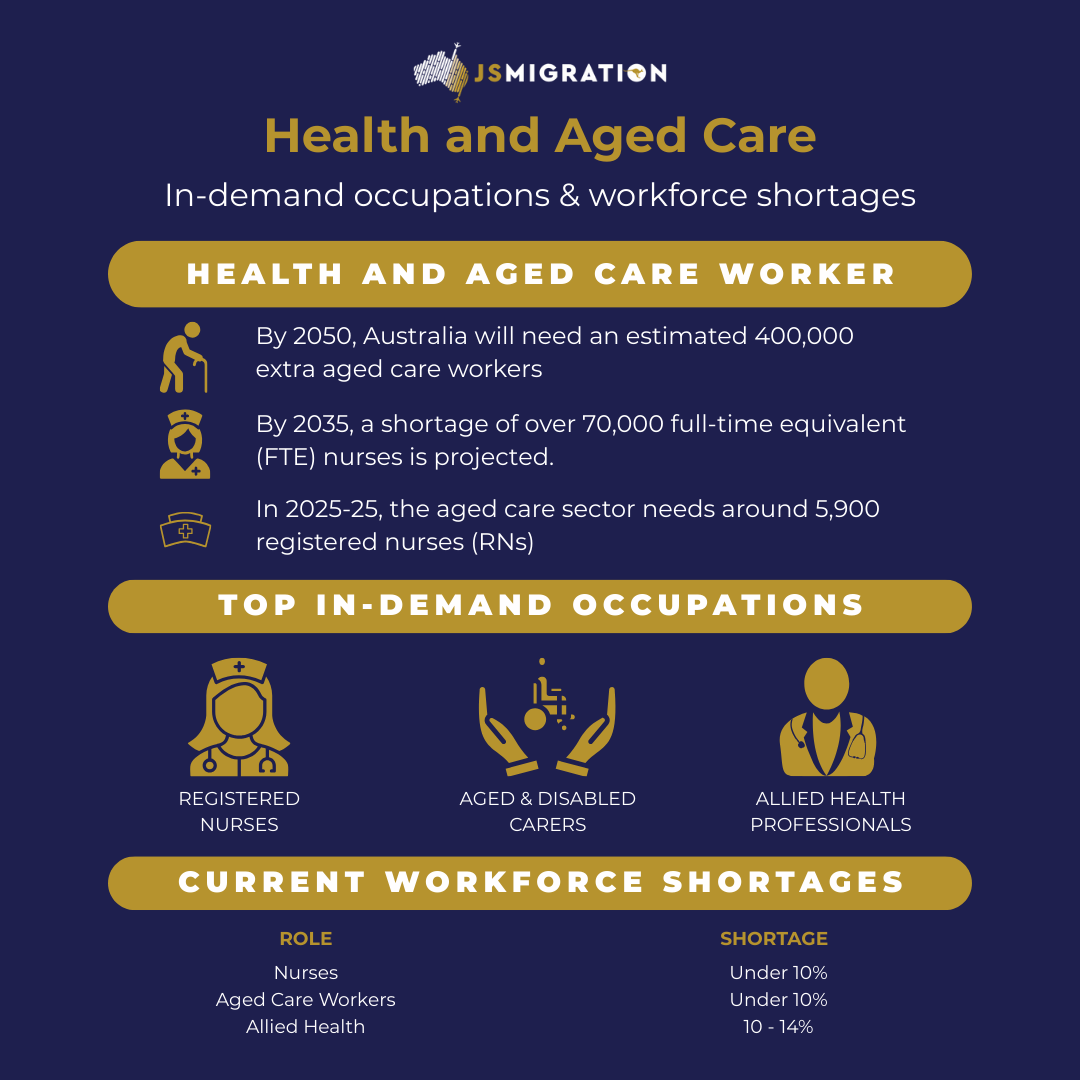
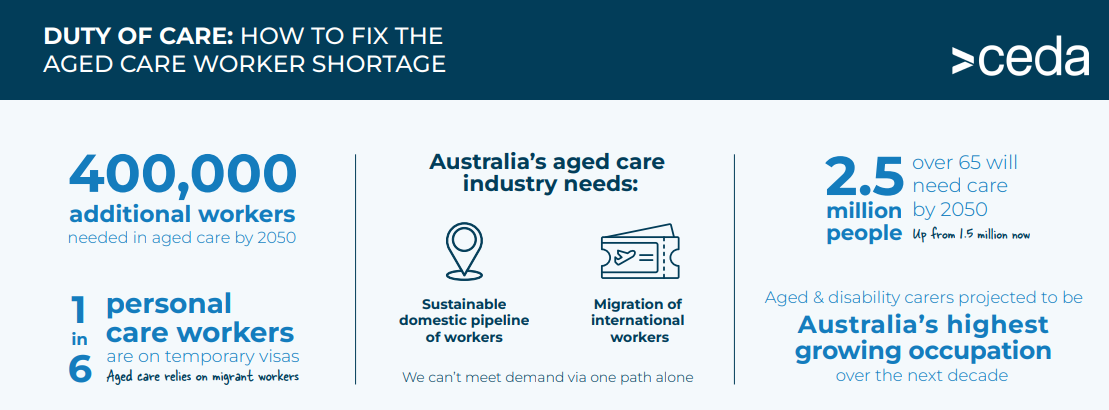
The demand for aged care and health services in Australia is rising sharply due to demographic shifts. Projections show that by 2050, the country will need an additional 400,000 aged care workers to meet growing demand for residential and home‑based care.


Source: www.ceda.com.au | Duty of Care: How to Fix the Aged Care Worker Shortage 2025

Workforce modelling suggests that by 2035, there will be a substantial shortfall of nurses — estimates indicate Australia could face a shortage of more than 70,000 full-time equivalent (FTE) nurse roles. For the 2024–25 period alone, the aged‑care sector reportedly needs around 5,900 registered nurses (RNs) to fill current gaps in residential aged care.

Despite some easing in labour shortages overall, demand remains acute in health, aged care, and allied health occupations. The shortage is especially severe in regional and rural areas, where recruitment and retention are harder, but demand for services is growing equally. In short: supply is not keeping up with demand — and as Australia ages, this gap is only expected to widen.

Skilled Migrants: Why Health & Aged Care Offers Real Opportunity

For internationally‑trained health or care professionals, the current environment in Australia offers a compelling entry point. Here’s why and how you can take advantage:

High‑Demand Occupations

Some of the roles in greatest demand:

  • Registered Nurses (RNs) — especially those with experience or willingness to work in aged care, aged‑care residential homes, or home‑based care.
  • Aged & Disabled Carers / Personal Care Workersdemand for carers remains high as aged care demand surges and the local labour supply lags.
  • Allied Health Professionals — physiotherapists, occupational therapists, community health workers and similar allied‑care roles are also increasingly needed, particularly in under-served regional areas.

Visa & Migration Pathways

Given persistent shortages, Australia remains open to overseas applicants to fill critical health roles. For qualified migrants, key pathways often include:

  • Employer‑sponsored visas (for those who secure a job offer), especially for nursing and care roles.
  • State‑ or territory‑nominated skilled‑migration visas — some states give priority to health and aged‑care occupations.
  • Roles in aged care or allied health may also qualify for relevant skilled occupation lists, depending on demand and required credentials.

What Migrants Should Do to Prepare

If you’re considering migrating to Australia to work in health or aged care:

  1. Obtain relevant credentials and credentials assessment — ensure your degree or qualification meets Australian standards. Many employers will only consider internationally qualified candidates who have had their credentials assessed.
  2. Highlight experience & specialization — RNs with aged‑care, geriatric, home‑care, or community care experience are especially sought after.
  3. Be open to location flexibility — while metro areas have competition, regional or remote areas often offer higher demand, easier placement, and potentially faster pathways for visa sponsorship or permanent residency.
  4. Prepare for registration/licensing requirements — Australia may require registration via its national nursing or health practitioner boards before you can work.
  5. Craft a strong, recruiter‑ready CV and gather references — employers are under pressure to fill roles quickly; having credentials, references, and readiness to start can boost your chances significantly.

Bottom line for migrants: If you’re qualified, experienced, and flexible, now is an excellent time to consider migrating to Australia’s health and aged care sector. Demand is strong, and pathways remain accessible.

Employers: How to Address Workforce Gaps via Overseas Recruitment

For aged-care providers, hospitals, clinics, and community health services — the shortage of locally available staff poses real risks to service quality, compliance, and long‑term sustainability. Overseas recruitment and sponsorship can be a viable solution.

Why Overseas Recruitment Makes Sense

  • Local supply of nurses and carers is not keeping pace with demand, especially in aged care and regional areas.
  • Relying solely on domestic labour may result in unfilled vacancies, overworked staff, high turnover, and inability to meet required care standards (e.g. mandated RN care-minutes, 24/7 coverage in facilities).
  • Overseas-trained professionals often bring critical skills, flexibility, and willingness to work in under-served roles (e.g. personal care, community care, regional placements), helping providers meet care demands.

Sponsorship & Hiring Options for Employers

Employers considering hiring internationally can explore:

  • Sponsoring qualified overseas nurses or carers — with employment offers, subject to immigration and registration requirements.
  • Working with migration agents or recruitment specialists to handle visa applications, skills assessments, credential verification, and compliance with regulation.
  • Targeting regional or high‑need areas where demand and shortage are higher — often easier to secure sponsorship and offer competitive packages.
  • Structured onboarding and support — assisting overseas hires with credentialing, registration, orientation to Australian standards, and community integration to improve retention.

Employer “Checklist” for Recruitment & Sponsorship

Before recruiting overseas care workers, providers should:

  1. Audit workforce needs — identify roles most urgently in shortage (e.g. RNs, personal carers, allied health).
  2. Ensure compliance with care standards — many aged care regulations now require 24/7 RN availability and minimum direct‑care minutes per resident.
  3. Plan for credential assessment & registration — ensure that overseas candidates meet Australian regulatory standards (licensing, skills check, possibly bridging courses).
  4. Provide support for orientation and retention — cultural onboarding, mentoring, career progression paths, and local support to reduce turnover.
  5. Consider strategic workforce planning — combine overseas hiring with domestic recruitment (e.g. trainees, apprenticeships) to build a stable, diverse workforce for the long term.

Bottom line for employers: Overseas recruitment is not just a short-term fix — when done right, it’s a strategic investment in capacity, compliance, and sustainable service delivery.

What This Means for the Future

  • The demand for health and aged care workers will only multiply as Australia’s population ages. Without significant workforce growth, gaps will widen — especially in rural and regional areas.
  • Employers who proactively recruit and sponsor overseas workers are likely to gain a significant advantage — ensuring they can meet care standards and maintain service quality.
  • Skilled migrants with healthcare qualifications stand to benefit: demand remains high, pathways are open, and chances of securing employment and visa sponsorship are greater than in many other sectors.
  • Regional placement, flexibility, and willingness to work in aged care or allied health significantly increase the odds of success — for both migrants and employers.

What You Should Do Next

For Migrants: If you have healthcare or caregiving qualifications — especially in nursing, aged care, or allied health — now is a strategic time to consider migrating to Australia. Start by assessing your credentials, preparing your documentation, and targeting roles and regions with high demand.

For Employers: Don’t wait until shortages cripple your services. Audit your staffing needs now, identify which roles are hardest to fill, and explore overseas recruitment and sponsorship as a forward-looking solution.

Opportunities are here — don’t wait. If this feels like your moment, let’s talk about how to make it real.