
Australia Net Migration at Record High: Why This Is a Big Opportunity for Migrants — and Why You Should Act Now

Australia is seeing unprecedented levels of long-term migration in 2025. According to data analyzed by the Institute of Public Affairs (IPA), net permanent and long-term arrivals (NPLT) have reached record highs.

Rather than viewing this surge as a sign that “migration is overcrowding,” it’s more helpful to understand it as a strong signal: there is genuine demand in Australia for people who plan to stay and contribute long-term. For skilled migrants, this is a major opportunity. But it’s also a moment to act strategically — because visa places are limited, and the current “wave” may not be sustainable forever.

What the Latest Data Really Says (Based on ABS)
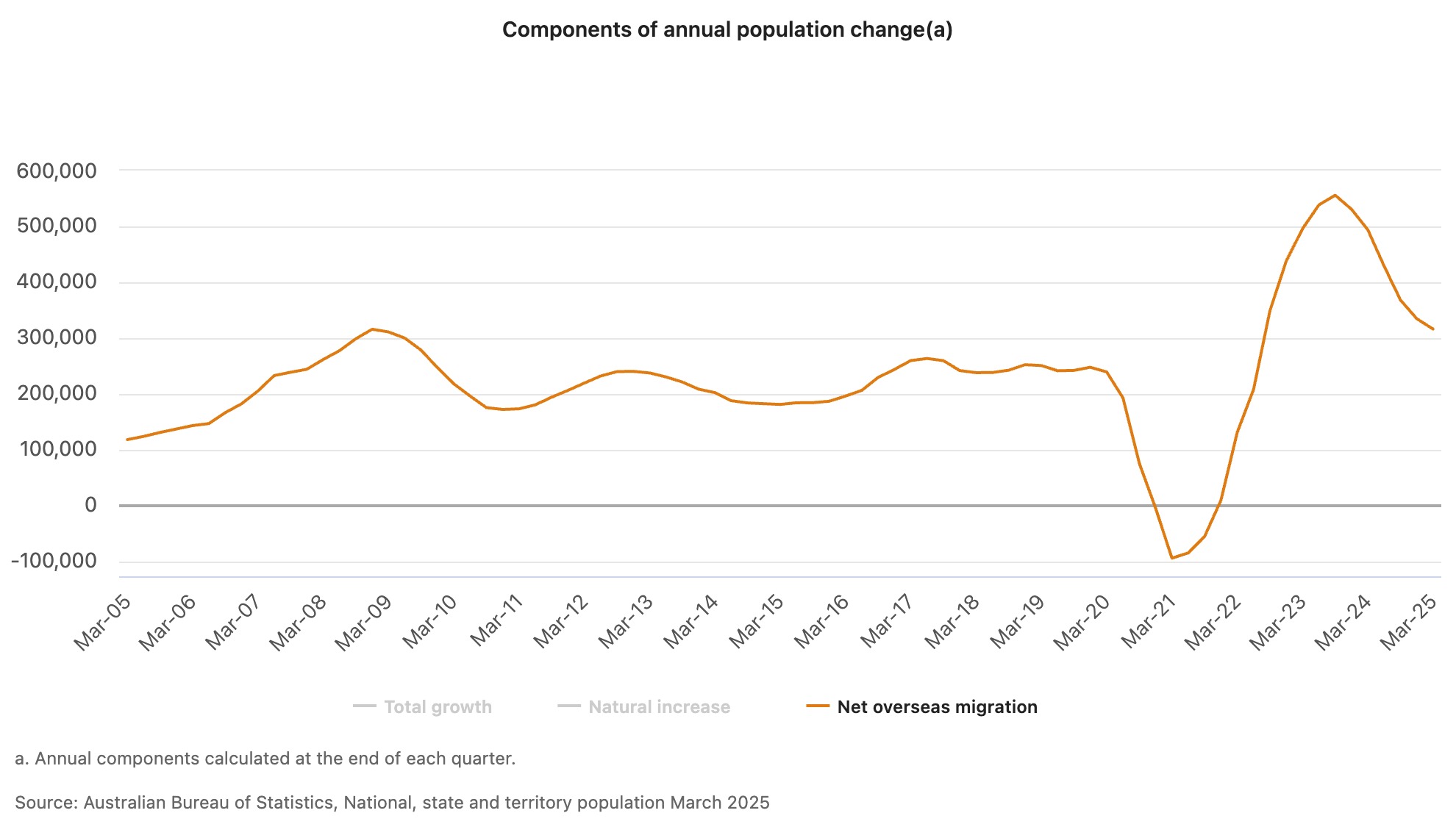
According to the ABS’s National, State and Territory Population release (year to 31 March 2025), net overseas migration (NOM) — the official measure of migration — was 315,900 people.

This means migration is making a very strong contribution to Australia’s population growth: out of 423,400 people added to the population in that 12‑month period, around 75% came from overseas migration.
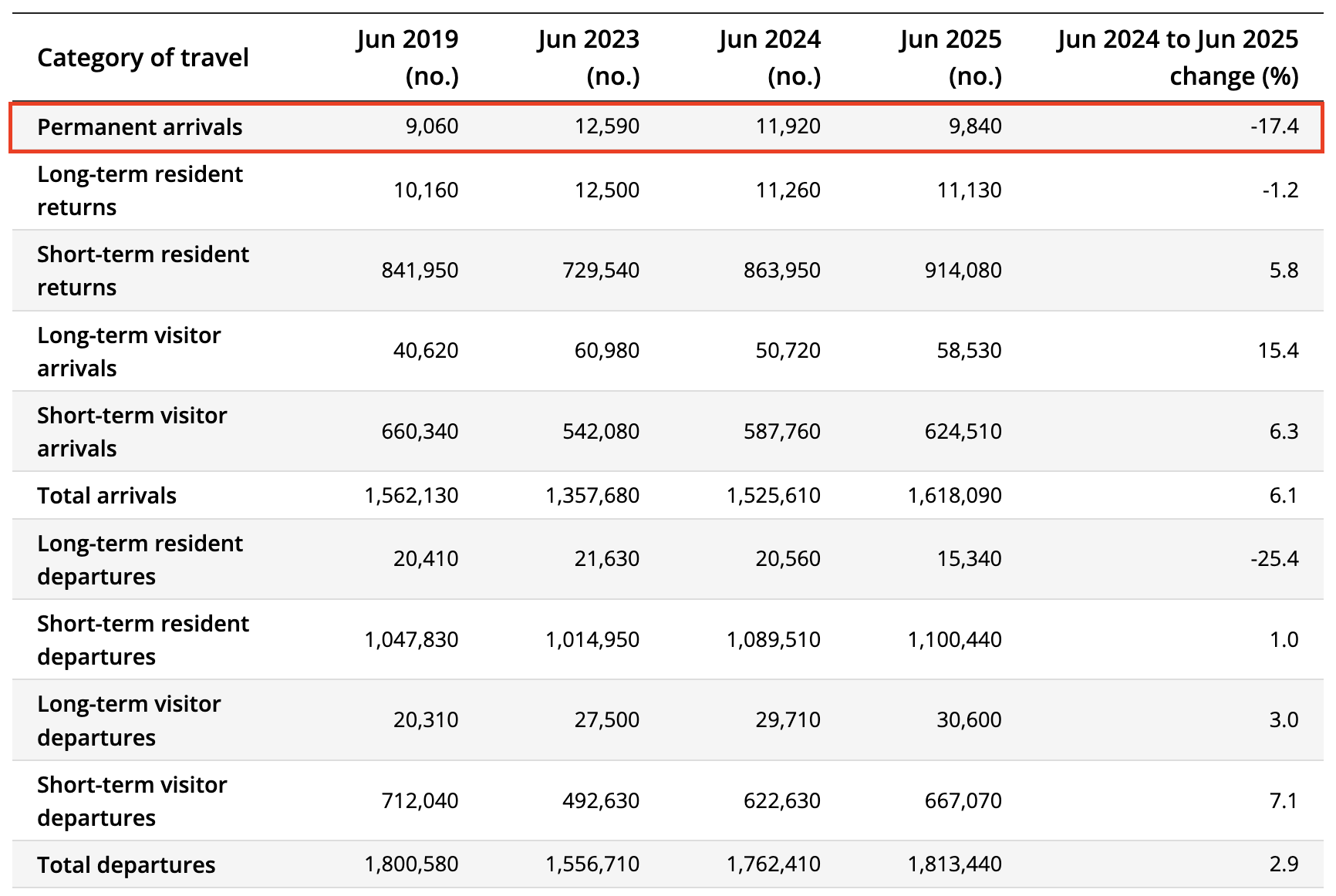
Looking at the ABS’s Overseas Arrivals and Departures data (June 2025 release), the net “permanent arrivals” (people who arrive declaring they intend to stay) was 9,840 for that month.

This “permanent arrivals” + “long-term resident returns” data from ABS provides a leading indicator of migration — not everyone who says they intend to stay will apply for permanent residency, but many do.

Putting these together: the ABS data shows a very strong inflow of people declaring long stays, and the NOM number confirms that a substantial part of that is translating into real, long-term population growth.

What that implies:

These ABS figures tell us that migration to Australia is not a short-term blip or just tourists coming in and out. A large portion of people arriving intend to stay — and a big chunk of them actually do. For someone planning to migrate, this suggests two things:

Demand is real: Australia continues to welcome people who plan to build their lives here.

Now is a good moment: Because migration is strong, there’s momentum — but places (in visa programs, for example) are not unlimited. Waiting too long could mean missing out.

Why This Is a Very Positive Signal for Migrants

High Demand for Long-Term Migrants

These record NPLT figures show Australia is not just taking in people for short stays — it needs people who will live and work here long-term. For migrants, this means that there is real appetite for stable, skilled immigration.

Stable Migration Cap = Predictability

The Australian government has set the 185,000 permanent migration places cap for 2025–26.

  • This cap hasn’t been raised dramatically, but it’s large enough to allow for many skilled and deserving migrants.
  • Having a cap gives you clarity: the program isn’t unlimited, but it’s also not shrinking.

Strategic Economic Planning

By bringing in more people who plan to stay, Australia can fill labor shortages, support economic growth, and strengthen its workforce. For migrants, that means more opportunities to secure jobs, build a career, and settle down.

Long-Term Residency is in Focus

Because many of these arrivals are “permanent and long-term,” the data suggests that these are not stopovers — these are people building careers and lives in Australia. If you’re serious about migrating, this is the kind of window you want to be part of.

What to Be Careful About — and Why It’s Not All Risk

Even with a positive outlook, there are potential risks. But being thoughtful can help you navigate them:

Public Debate Is Heating Up

With these record numbers, conversations in Australia about housing, infrastructure, and social services are becoming more intense. While that could lead to policy changes, the current migration program remains strong.

Visa Places May Fill Up

Even though the cap is high, the most popular visa streams (especially for skilled migrants) might reach capacity. That means the sooner you apply, the better your chances.

Policy Changes Are Always Possible

Immigration rules can change. But for now, the cap is stable, and skilled migration remains a strong priority.

Practical Advice: How to Take Advantage of This Moment

Here are simple, actionable steps for prospective migrants who want to make the most of this favorable situation:

Start Your Application Early

Don’t wait. With high demand, applying sooner gives you a better shot before spots run out or rules tighten.

Choose the Right Visa Path

Focus on skilled visa categories — particularly ones that align with what employers need. Think about employer‑sponsored visas or state-nominated visas if they make sense for your situation.

Consider Regional Options

Some regional areas have more room and demand for migrants. These places might be less competitive and offer a better quality of life and support.

Work With a Trusted Migration Advisor

Use a registered migration agent or adviser who understands the 2025–26 migration program. They can help you pick the right visa, time your application, and avoid mistakes.

Be Prepared, Not Rushed

Get your documents ready: qualifications, work experience, skills assessments. Show that you’re serious, stable, and here for the long term.


The current migration surge in Australia isn’t just big — it’s strategic and sustained. This is a moment of strong demand, especially for people who plan to build their future here, not just stay temporarily.

For skilled migrants, now is an opportune time to act: to apply, to plan, and to make your move while the door is wide open. But it’s also a moment to be smart — apply early, choose the right visa, and work with good advice.

At JS Migration, we believe in helping people take advantage of these windows. If this feels like your moment, let’s talk about how to make it real.


Australia’s Accountant Shortage in 2025: Latest Data, Trends, and What It Means for Skilled Migrants

Australia’s demand for qualified accountants continues to grow this year. Recent data from Jobs and Skills Australia 2025 Occupation Shortage List (OSL) shows that shortages are not only persistent, but becoming more specialised.

Despite a cooling economy, businesses across Australia are still struggling to fill key accounting and finance roles, prompting strong calls from industry bodies to maintain (and in some areas, expand) skilled migration pathways.

If you’re an accounting professional exploring migration, or an employer looking to fill critical roles, here’s what the latest 2025 insights mean for you.

What the Latest 2025 Reports Are Saying

Accounting roles remain in shortage — nationally and regionally

The 2025 OSL report released by Jobs & Skills Australia shows improvement across the broader labour market — but accounting remains a clear pressure point. According to the report, fewer occupations are in shortage overall, but specialist accounting roles remain hard to fill, with employers reporting recruitment delays and limited talent availability.

A key body representing the profession, Chartered Accountants Australia and New Zealand (CA ANZ), has been vocal in its 2025 submissions:

  • Taxation Accountants, Management Accountants, and Finance Managers are experiencing national shortages.
  • Accountant (General), External Auditors, and Internal Auditors face state-level shortages, particularly in regional areas.
  • Roles with an estimated fill rate below 67% are flagged as “high-risk” occupations — and several accounting positions fall well under this threshold.

This should immediately signal to skilled migrants and employers. The gap between supply and demand is not closing — and businesses continue to rely on migration to fill these roles.

Hard Numbers: 2025 Fill Rates Show Significant Talent Gaps

A March 2025 analysis by Accounting Times based on CA ANZ’s member survey highlights the extent of the shortages:

  • Financial Investment Advisers: 29% fill rate
  • Finance Managers: 37% fill rate
  • Management Accountants: 45% fill rate
  • Taxation Accountants: 59% fill rate

In practical terms, this means:

  • A large portion of advertised positions remain unfilled, often for months.
  • Employers are widening search efforts and becoming more open to sponsorship.
  • Skilled migrants who match these occupations are entering the market with a significant advantage.

Regional areas are especially impacted. If you’re open to working outside major cities, demand is even stronger — and visa pathways can be more favorable.

Why Is Australia Facing an Accountant Shortage in 2025?

A shrinking domestic talent pipeline

CA ANZ reports that accounting degree enrolments have been declining since 2018, leaving fewer graduates to replace an ageing workforce. This downward trend continues in 2025.

Rising business complexity

With increased regulations, digital transformation, and cybersecurity obligations, demand for specialists in tax, audit, and financial compliance continues to climb.

Strong competition for talent

Accounting firms — especially in audit and tax — are competing for the same limited pool of professionals. Many are offering:

  • Higher salaries
  • Flexible work arrangements
  • Overseas recruitment and sponsorship
  • Career development incentives

Despite this, shortages persist.

Policy shifts affecting the pipeline

Changes proposed in the 2025 Federal Budget — including migration caps and stricter student visa settings — risk reducing the number of international graduates who traditionally enter accounting roles.

This means employers are becoming more reliant on experienced overseas professionals who can fill critical gaps.

Skilled Migration Outlook for Accountants in 2025

Accounting occupations remain recommended for the Core Skills Occupation List (CSOL)

In its 2025 submission to Jobs & Skills Australia, CA ANZ recommended that the following occupations remain on Australia’s skilled migration lists:

  • General Accountant
  • Taxation Accountant
  • Management Accountant
  • External Auditor
  • Internal Auditor
  • Finance Manager

They even proposed adding Forensic Accountant as an emerging priority occupation, reflecting growing demand in risk and compliance sectors.

For skilled migrants, this is an encouraging signal:

your skills are still considered critical to Australia’s economy.

Visa pathways likely to remain favourable for accounting roles

Because these occupations are widely recognised as “hard to fill,” accountants generally have strong prospects in:

  • Skilled Independent pathways (points-tested)
  • State nomination programs
  • Employer-sponsored visas
  • Regional visas such as the 491 and 494

While the migration landscape continues to shift in 2025, accounting roles consistently remain high-value, high-priority candidates for both government and employers.

What This Means If You’re an Accountant Considering Migration

Here’s the good news:

2025 is still an excellent time for accountants to explore migration to Australia.

With shortages in key roles and low fill rates across the country, experienced accountants — especially those with tax, audit, financial reporting, and management accounting backgrounds — remain highly competitive.

You’re likely to be in demand if you have experience in:

  • Tax compliance and advisory
  • External or internal audit
  • Financial management
  • Budgeting and forecasting
  • Assurance and regulatory reporting
  • Business analysis and planning

Strong English skills, professional body accreditation, and relevant software experience (e.g., Xero, MYOB, SAP) further boost your prospects.

What Employers Need to Know

If you’re an employer struggling to fill accounting roles, you are not alone.

Surveys from CA ANZ and the Hays 2025 Skills Report show that more than 80% of accounting and finance teams are facing staffing shortages.

This has two implications:

Skilled migration remains a strategic solution.

Many firms are now actively sponsoring overseas talent to stay competitive.

Acting early is crucial.

With migration policy tightening in some areas, businesses that prepare early — by identifying roles, planning sponsorship pathways, and understanding requirements — secure better outcomes.

2025 Is Still a Strong Year for Accounting Professionals

Despite improvements in other sectors, the accounting shortage remains one of Australia’s most persistent skill gaps.

The latest 2025 data shows:

  • Shortages remain across key accounting specialties
  • Employers continue to struggle with recruitment
  • Migration continues to play a critical role in workforce planning
  • Experienced accountants are in a strong position to take advantage of opportunities

At JS Migration, we’re here to help you navigate this landscape with clear, practical advice — whether you’re an accountant planning your move, or an employer searching for the right talent.

<aside>

Thinking about migrating as an accountant?

We’d love to guide you.

**Complete our enquiry form here and one of our team members will reach out to you directly.** We’ll walk you through your options, assess your eligibility, and help you take the next step with confidence.

</aside>

Understanding Your Responsibilities as a Standard Business Sponsor (SBS)

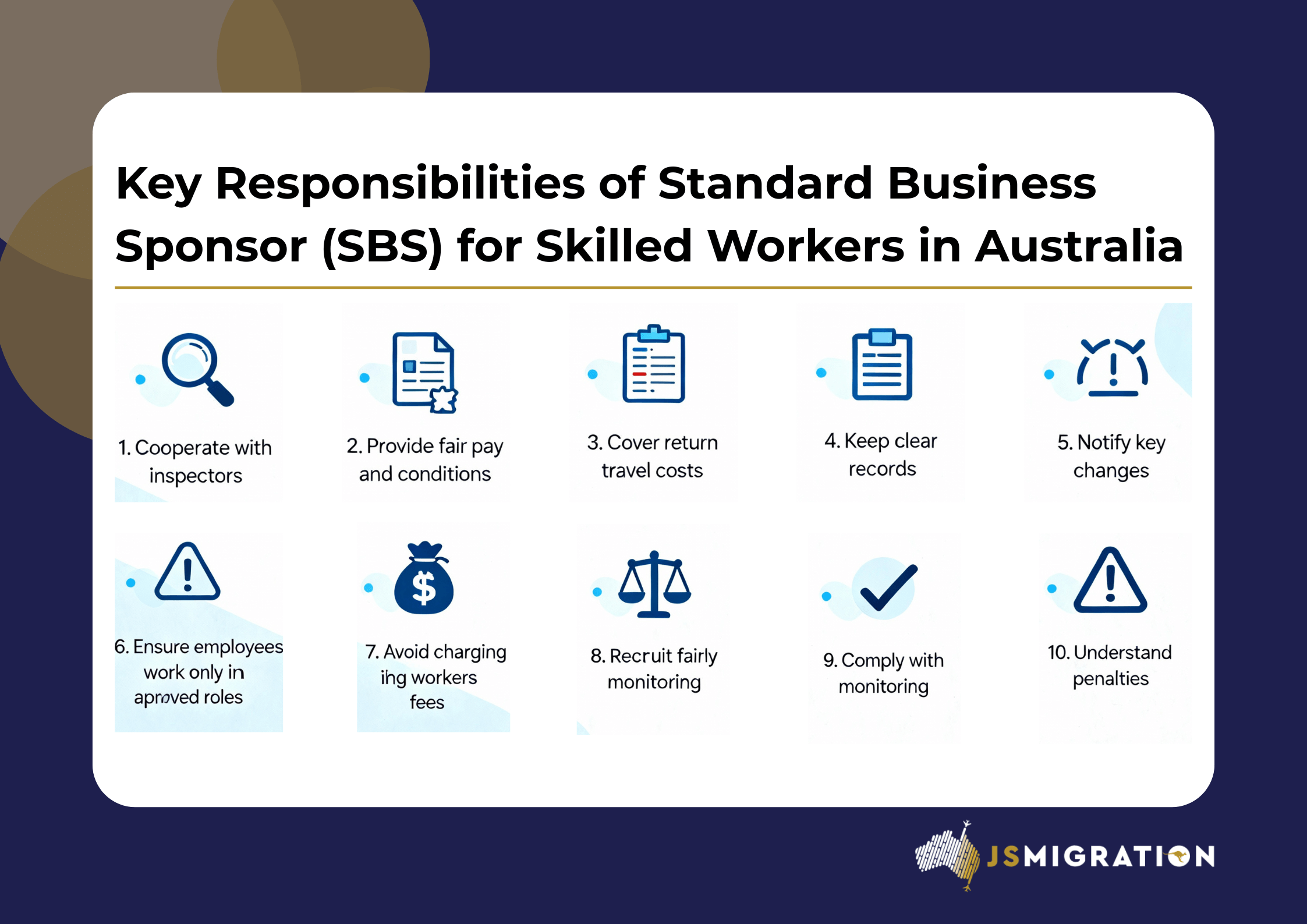
Sponsoring skilled workers through programs like the Temporary Skill Shortage (subclass 482) or Skilled Employer Sponsored Regional (subclass 494) means you have important obligations. These rules protect both Australian workers and your overseas hires and keep the sponsorship process fair and transparent.

In this post, we’ll outline the key legal obligations you need to understand before sponsoring your first skilled migrant employee. Knowing these requirements early helps your business stay compliant and ensures a smoother sponsorship process from start to finish.


Cooperate with Inspectors — Stay Ready

Expect visits or requests from Department of Home Affairs (DOHA) inspectors or other agencies. They might want to look at your records or speak with staff to check compliance. This oversight starts when your sponsorship is approved and lasts up to five years after it ends.

Fair Pay and Working Conditions — Treat Everyone Equally

Your sponsored employees should never be paid less or treated worse than their Australian counterparts in the same role. Their wages must match what you nominated, and working conditions should be equal or better—unless their income is above $250,000 per year, then some exceptions apply.

Cover Return Travel Costs — Helping Workers Go Home

If a sponsored worker (or their family) requests in writing to return to their home country, you’re responsible for reasonable travel expenses. This usually means economy flights back home.

Government Costs — Be Accountable if Workers Overstay

If the government must track down and remove a sponsored employee who overstays, your business might have to repay those removal costs—up to $10,000.

Keep Clear Records — Paperwork Matters

Maintain thorough and verifiable records, including employment contracts, job duties, business turnover for levies, and any training benchmarks if relevant. Keep everything for at least five years in case DOHA asks to review them.

Provide Information When Asked — Respond Promptly

When the Minister or DOHA asks for information or documents, reply within the timeframe specified to avoid issues.

Notify DOHA About Important Changes — Keep Them in the Loop

Within 28 days, inform DOHA if an employee stops working for you, changes roles, or if there are changes in business ownership, insolvency, or your contact details.

Sponsored Employees Must Stick to Approved Roles — No Side Gigs

Workers should only perform the duties listed in their approved nomination. They must be directly employed by you or your associated company — not loaned out to others.

Don’t Shift Sponsorship Costs to Employees — You Cover It

You cannot charge your sponsored workers any fees for sponsorship, visa processing, recruitment, or government levies. These remain your obligation as the employer.

Recruit Fairly — No Discrimination Allowed

Use visa programs only to fill genuine skill shortages after checking for suitable Australian candidates. Recruitment should always be nondiscriminatory, regardless of nationality or visa status.

Compliance Checks and Monitoring — They’re Watching

DOHA regularly monitors sponsors through document requests, site visits (often unannounced), and data sharing with agencies like the ATO or Fair Work Ombudsman.

Penalties for Non-Compliance — Serious Consequences

Failing to meet your obligations can lead to sponsorship suspension, cancellation, future bans, public naming, fines up to $63,000 per breach, or even legal action.


💡 Need Help Navigating Your Sponsorship Duties?

Understanding these rules might feel overwhelming, but you don’t have to face it alone. If you receive monitoring requests or want to double-check your compliance, contact JS Migration right away. Acting early can save you from bigger problems down the line.

NIV Invitation Rounds 2025: Priority Levels and what it means for you

If you’ve been following Australia’s National Innovation Visa (NIV), you might be wondering — are invitation rounds still happening? What are the latest priorities? And how can you make your Expression of Interest (EOI) stand out? Even if it feels like you’re late to compete with other applicants, don’t worry — there are still clear signals and practical steps you can take right now to strengthen your position.

On this article, we will give a few tips to strengthen your EOI and have a better understanding on how your profile stands towards a positive outcome.

What NIV invitation rounds are about

The NIV is an invitation-based migration pathway. Each invitations to apply don’t guarantee a visa approval; it is an extra step that will allow you to submit a full application to the Department of Home Affairs. It will require you to have strong documentation that will prove your exceptional and outstanding achievement within your field of industry.

Invitations are rolled out on monthly rounds. There’s a predictable tempo where some rounds delivering several invitations and others more modestly populated depending on the department’s capacity and pool of eligible EOIs. If a round doesn’t provide invitations for a particular candidate, there will be another round soon.

The department applies a four-tier priority frame work to guide who will get invitations first.

NIV four-priority levels

  • Priority 1 – Exceptional candidates from any sector who are global experts and recipients of international ‘top of field’ level awards.What it mean: This group often includes individuals with internationally recognized top-tier awards or milestones and is the most likely to receive invitations in the earliest rounds.
  • Priority 2 – Candidates from any sector nominated on the approved Form 1000 by an expert Australian Commonwealth, State or Territory Government agency. What it mean: Government-nominated or highly endorsed profiles. This includes cases where a recognized government agency or similar body backs the candidate, signaling strong alignment with national priorities.
  • Priority 3 – Candidates with exceptional and outstanding achievements in a Tier One sector:
    • Critical Technologies
    • Health Industries
    • Renewables and low emission technologies

    What it mean: Tier 1 sector achievers. Applicants demonstrating exceptional and outstanding achievements in Tier 1 sectors—high-impact areas identified by the NIV program (e.g., critical technologies, health, renewable energy)—with compelling evidence of impact and leadership.

  • Priority 4 – Candidates with exceptional and outstanding achievements in a Tier Two sector:
    • Agri-food and AgTech
    • Defence Capabilities and Space
    • Education
    • Financial Services and FinTech
    • Infrastructure and Transport
    • Resources

    What it mean: Tier 2 sector achievers. Applicants with exceptional achievements in Tier 2 sectors (broadly supportive to the national innovation ecosystem, such as Agri-Food/AgTech, resources, infrastructure, education, etc.). These still demonstrate meaningful economic or societal contributions.

What July and September invitations looked like — Expert interpretation

July invitations: In practice, July rounds typically reflected a mix of high-priority cases (Prioity 1 and 2). Robust Tier 1/2 submissions that clearly aligned with current national priorities. The volume may vary, but high-caliber profiles with verifiable impact and international recognition tended to be favored for invitations.

September rounds often continued the pattern of prioritizing strong Priority 1-2 cases, with a healthy share of Tier 1 sector accomplishments in the mix. For applicants, this underscored the importance of tight alignment to NIV priorities and the strength of the documentary evidence supporting exceptional and outstanding achievements.

Your Migration Strategy Matters

As mentioned, we will provide a few tips to strengthen your profile, read through the items below to help you start:

  • Prepare with the priorities in mind: Your EOI should explicitly map each achievement to the NIV priority framework. Even if the exact round numbers aren’t published in real time, a well-structured narrative that links your work to Priority 1–4 will improve your positioning in any monthly batch.
  • Evidence is king: Gather and curate robust, verifiable documentation—international awards, leadership roles, significant patents or publications, high-level collaborations, and evidence of tangible impact. The stronger the evidence, the more compelling the invitation case becomes.
  • Don’t forget the nomination angle: If applicable, state or territory nominations can complement NIV eligibility and increase your exposure to invitation rounds in the right cycle. Aligning any nomination with NIV priorities can be advantageous.
  • Stay ready for the full application: An invitation triggers the actual application, which requires comprehensive documentation, references, and detailed narratives. The better prepared the applicant, the smoother the transition from invitation to lodge.

A Sneak Peak Through JS Migration’s Practical Plan

  • Do a priority-by-priority audit: Create a one-page map that ties each achievement to Priority 1 through Priority 4. This helps you quickly adjust EOIs if needed and stay focused on what the department is looking for.
  • Build a ready-to-submit documents: Assemble core documents now—identity proof, evidence of awards or recognitions, letters of nomination/support, and robust reference letters. Your future self will thank you the moment an invitation lands.
  • Monitor and refresh: Regularly update your EOI with new achievements and ensure all attachments reflect your most current profile. Monthly invitation cycles mean timing can tip the balance in your favor if readiness is maintained.
  • Consider parallel pathways: If state nominations or other visa streams align with a client’s profile, prepare those tracks in parallel where feasible to maximize opportunities.

If you’re aiming to stand out against other applicants and be ready to lodge the visa application the moment an invitation arrives, contact JS Migration now. We’re passionate about helping you craft your future in Australia.